
If you’ve ever lain awake at night with your mind racing, you already know this truth: fear and uncertainty are enemies of sleep.
When the brain doesn’t understand what’s happening, it fills the gap with worry. That worry keeps the nervous system alert, which blocks sleep.
Many people don’t realize that understanding real science can be deeply calming. When you know what your body is doing and what it doesn’t need to do, your nervous system can relax.
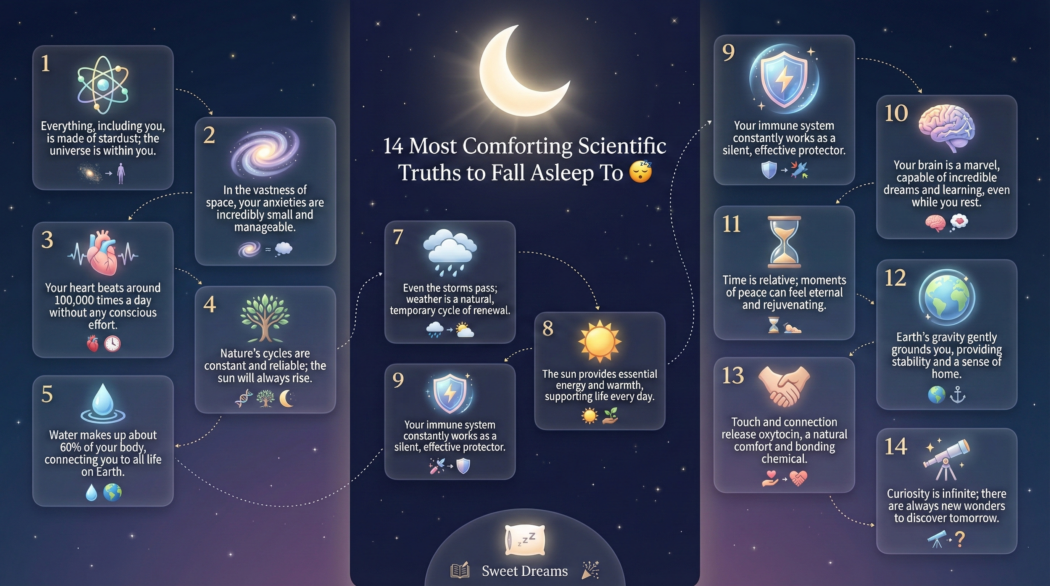
This article shares the most comforting, science-backed truths about sleep, anxiety, and the brain. These aren’t motivational quotes or vague ideas. They’re biological facts that help the body feel safe enough to rest.
Why Does Understanding Sleep Help You Fall Asleep?
Understanding sleep helps you fall asleep by reducing fear and uncertainty, which lowers nervous system alertness. When the brain feels safe and informed, sleep can occur naturally without effort or forcing it.
1. Your Body Knows How to Sleep — Even When You Think It Doesn’t
Sleep is not something you “perform.”
It’s an automatic biological process.
Two systems regulate sleep whether you try or not:
- Sleep drive (adenosine buildup)
- Circadian rhythm (your internal clock)
Even on nights when you feel wide awake, these systems continue working quietly in the background. You cannot lose the ability to sleep.
This is why many people sleep “enough” but still wake up exhausted. Sleep timing happened, but recovery didn’t. That pattern is explained in Why You Wake Up Tired Even After 8 Hours of Sleep.
Comforting truth:
You don’t need more effort. Trying harder often keeps sleep away.
🌙 If your mind stays alert at night, supporting calm and sleep depth, not forcing sleep, can help.
👉 Support deeper, more restorative sleep with YuSleep
2. Lying Awake Is Still Restful for the Brain
Many people panic when they’re awake in bed because they believe:
“If I’m not sleeping, the night is wasted.”
But quiet wakefulness still allows:
- Reduced metabolic demand
- Lower cortisol levels
- Partial neural recovery
The brain doesn’t work in an all-or-nothing way.
Comforting truth:
Even when you’re awake, your body is still resting.
This is especially important for people who wake frequently or feel their sleep is “too light.” This pattern is discussed in How to Sleep Longer Than 6 Hours.
3. You Don’t Need Perfect Sleep to Function Tomorrow
Sleep anxiety is fueled by catastrophic thinking:
“If I don’t sleep, tomorrow will be a disaster.”
Research shows:
- Performance drops far less than expected.
- Mood matters more than total sleep time.
- The brain compensates surprisingly well in the short term.
Comforting truth:
One imperfect night does not ruin you.
4. The Brain Cannot Stay Alert Forever
Sustained wakefulness is biologically impossible.
Eventually:
- Adenosine pressure rises
- Stress hormones fall
- Micro-sleep episodes occur
Even people with severe insomnia still get small amounts of sleep they don’t remember.
Comforting truth:
Your brain will sleep whether you allow it or not.
5. Anxiety Feels Dangerous — But It Isn’t
At night, anxiety feels stronger and more physical.
Scientifically:
- Anxiety is a false alarm.
- The sensations are uncomfortable, not harmful.
- Adrenaline does not rise forever.
- The nervous system always returns to baseline.
Comforting truth:
Nothing bad is happening. Your body is being overly protective.
For people whose anxiety shows up as racing thoughts or tension at night, supporting relaxation pathways can help. Many explore the combination of L-theanine and GABA for nighttime calm.
6. Nighttime Thoughts Are Less Accurate Than Daytime Thoughts
At night:
- The amygdala becomes more reactive.
- Rational filtering decreases
- Threat perception increases
That’s why worries feel bigger after dark.
Comforting truth:
If a thought feels overwhelming at night, it will feel different in the morning.
7. You Don’t Have to Relax Perfectly to Fall Asleep
Sleep does not require:
- A quiet mind
- Perfect calm
- Zero anxiety
People fall asleep during stress, noise, and emotional moments.
Sleep happens when alertness gradually fades—not when it disappears completely.
You don’t need to fix your mind to fall asleep.
😴 If calming down is the hardest part of your night, gentle nervous-system support can help your body transition into deeper sleep.
👉 Explore YuSleep for calmer nights and better recovery
8. Sleep Debt Is Real — and It Repays Itself
Your body tracks missed sleep automatically.
After poor sleep:
- Sleep drive increases
- Deep sleep rebounds
- Recovery stages are prioritized.
You don’t need to force yourself to catch up on sleep.
Comforting truth:
Your body already knows how to recover.
9. Insomnia Is Maintained by Fear — Not Damage
Chronic sleep problems are rarely caused by a broken system.
They’re often maintained by:
- Hypervigilance
- Fear of not sleeping
- Constant monitoring
When fear drops, sleep often returns.
Comforting truth:
Nothing is broken in you.
10. The Brain Likes Familiar Nighttime Signals
Predictability calms the nervous system.
Repeated cues signal safety:
- Same lights
- Same sounds
- Same wind-down routine
This is why routines help. They reduce uncertainty.
11. You Are Not Failing at Sleep
Sleep is not a skill you perform.
It’s a biological state that emerges when conditions feel safe.
Judging yourself increases alertness.
Comforting truth:
You’re not bad at sleep. You’re human.
12. Waking Up at the Same Time Every Night Is Often Predictable
Repeated early awakenings are often linked to:
- Circadian rhythm timing
- Stress hormones
- Blood sugar changes
This pattern is explained in Why You Wake Up at the Same Time Every Night.
13. Your Nervous System Is Always Trying to Protect You
Even sleeplessness has a purpose:
- Heightened alertness during perceived threat
Your system isn’t broken. It’s cautious.
14. Sleep Returns When Threat Perception Fades
When fear decreases and safety increases, sleep often returns naturally.
Comforting truth:
Sleep is usually closer than it feels.
How to Use These Truths at Bedtime
Instead of fighting thoughts, gently repeat:
- “My body knows how to sleep.”
- “Even resting is helpful.”
- “Nothing needs to happen right now.”
- “This will feel different in the morning.”
FAQs
Can understanding sleep really help with insomnia?
Yes. Reducing fear and uncertainty lowers nervous system alertness, allowing sleep to occur naturally.
Is lying awake bad for my brain?
No. Calm wakefulness still provides physical and neural rest.
Why do I feel tired even after sleeping?
Often due to poor sleep depth or fragmentation, not sleep time alone.
Can supplements help without forcing sleep?
Yes. Some support calm and recovery rather than sedation.
Final Thoughts: Science as a Sleep Aid
You don’t need more pressure or effort.
Sometimes, the most effective sleep support is understanding.
🌙 If light, restless sleep keeps you from feeling restored, supporting deeper recovery can help your body do what it already knows how to do.