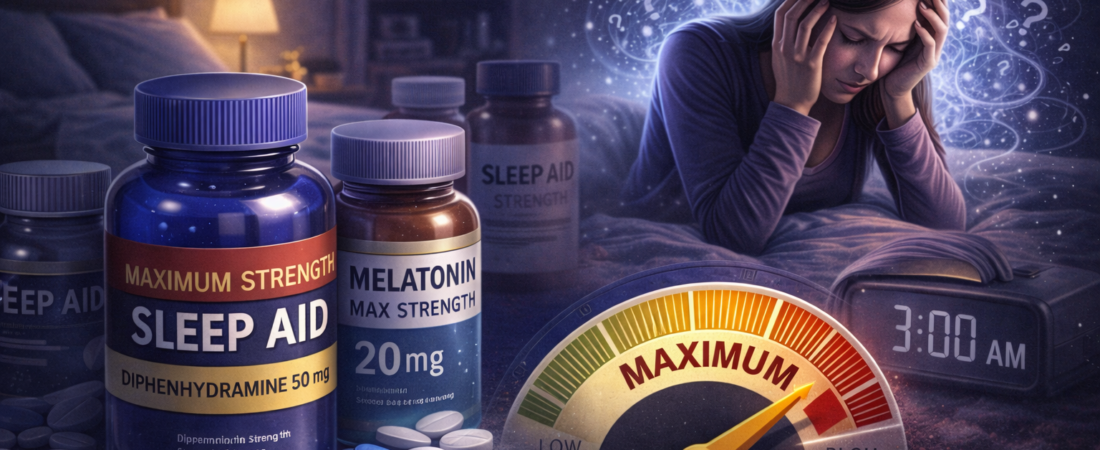
Sleep deprivation has a way of changing how we think. When regular sleep aids fail, many turn to “maximum strength” products, hoping a higher dose or more potent formula will deliver the best results.
But do these products actually work better? Or do they simply sedate harder while leaving the real sleep problem untouched?
This article explains what “maximum strength” means, how these aids actually perform, and whether choosing the strongest option leads to better sleep or just more side effects.
Understanding What “Maximum Strength” Really Means
What does “maximum strength” mean on sleep aids?
Maximum strength sleep aids usually contain higher doses of existing ingredients, not stronger or more effective sleep mechanisms.
The phrase maximum strength sounds clinical and credible, but in reality, it’s largely a marketing label, not a standardized medical category.
What it usually indicates
In most cases, “maximum strength” means:
- A higher dose of an existing active ingredient
- The strongest dose allowed without a prescription.
- A combination of sedating ingredients rather than a new mechanism
It does not mean:
- Better sleep quality
- Deeper renewing sleep
- Prolonged effectiveness
This distinction matters—especially for chronic insomnia.
Overview: What’s Inside Maximum Strength Sleep Aids
Do maximum strength sleep aids work better?
They may increase sedation in the short term, but they don’t reliably improve sleep quality or long-term insomnia.
Most maximum strength OTC sleep aids rely on one (or more) of the following:
Diphenhydramine
- Sedating antihistamine
- Found in many “PM” products
- Often increased from 25 mg to 50 mg in max-strength versions.
Doxylamine
- Another sedating antihistamine
- Often described as “stronger” or longer-lasting
- Higher likelihood of next-day grogginess
High-Dose Melatonin
- Often 10–20 mg (far above physiological levels)
- Has the potential to disturb innate circadian signaling when overused
Herbal Blends
- Valerian root, passionflower, magnesium, L-theanine
- Strength claims are often based on total milligrams rather than effectiveness.
Why Strength Claims Are Confusing
Unlike prescription medications, OTC sleep aids:
- They are not standardized for “strength.”
- Use different methods among various products.
- Affect people very differently.
As a result, stronger does not mean more effective—just more sedating.
Performance Analysis: Do They Actually Work Better?
Short-Term Results
A lot of users say:
- Faster sleep onset (initially)
- Heavier sedation
- Fewer early awakenings at first
This creates the impression that maximum strength products are superior.
But this effect is often temporary.
What Happens Over Time
With repeated use, many people experience:
- Tolerance (needing higher doses)
- Rebound insomnia
- More interrupted sleep
- Reduced deep and REM sleep
- Increased next-day fatigue
Sedation increases, but sleep quality often declines.
Why Sedation ≠ Refreshing Sleep
Sleep isn’t just unconsciousness.
refreshing sleep requires:
- Stable sleep cycles
- Adequate deep sleep
- Nervous system downregulation
Maximum strength sleep aids often suppress wakefulness without addressing hyperarousal, which is why sleep may feel longer but less refreshing.
Short summary:
When stronger sleep aids stop working, the issue is often not the dose, but the underlying cause of insomnia.
👉 Take the first step: explore the real reasons behind chronic insomnia and discover effective strategies beyond maximum strength aids.
Root Causes of Chronic Insomnia & What Actually Helps
Pros and Cons of Maximum Strength Sleep Aids
Advantages
- Widely available
- No prescription required
- Can help with short-term, situational insomnia
- Familiar ingredients
Drawbacks
- Increased grogginess along with “hangover” effect
- Reduced sleep quality over time
- Poor fit for anxiety-driven insomnia
- Limited effectiveness for sleep maintenance
- Risk of dependence on sedation rather than sleep control
User Experience: What People Actually Report
Across forums, reviews, and clinical observations, patterns emerge:
Common experiences include:
- “I fall asleep, but wake up feeling awful.”
- “They worked for a week, then stopped.”
- “I sleep longer yet feel less rested.”
- “My anxiety feels worse at night.”
This is especially common among adults over 45, whose sleep becomes more sensitive to disruption and medication side effects.
Why Maximum Strength Often Fails for Chronic Insomnia
Chronic insomnia is rarely caused by a lack of sedation.
It is more commonly driven by:
- Nervous system hyperarousal
- Anxiety and stress
- disturbed sleep cycles
- Circadian rhythm disruption
Increasing sedative strength does not resolve these issues—and may worsen them over time.
If sleep aids make you drowsy but not rested, sleep quality—not strength—may be the missing piece.
👉 This guide explains why sleep fragmentation matters more than sleep duration for feeling rested.
Value for Money: Are Maximum Strength Sleep Aids Worth It?
From a cost perspective:
- Maximum strength versions are usually more expensive.
- They don’t last longer in effectiveness.
- Many users cycle through brands without improvement.
For occasional use, they may be used for ease of use.
For ongoing insomnia, the return on investment is often poor—especially when side effects accumulate.
When People Start Looking Beyond Pills
After months or years of cycling through stronger OTC options, many readers reach a turning point:
- They want to sleep seems natural.
- They want fewer side effects.
- They want solutions that work with the nervous system.
This is often when non-pill methods become appealing—especially for anxiety-driven or elevated sleep.
If your insomnia is driven by stress or racing thoughts, sedation alone may never address the real issue.
Final Verdict: Are “Maximum Strength” Sleep Aids Really Better?
Maximum strength sleep aids are not inherently bad—but they are often misunderstood.
They can:
- Help temporarily
- Mask symptoms
- Increase sedation
But they rarely:
- Improve sleep architecture
- Address anxiety-driven insomnia
- Deliver lasting improvement
For chronic insomnia, stronger isn’t better—smarter is.
Understanding why sleep breaks down—and choosing approaches aligned with that cause—is what ultimately leads to better nights and better days. Choosing the strongest sleep aid over the counter isn’t always the same as choosing what helps long-term sleep quality.