
Introduction: Why Sleep Schedules Matter More Than Sleep Tips
For night shift workers, sleep problems are rarely about motivation or discipline. They’re about timing.
Perfect sleep habits can’t compensate for a sleep schedule that clashes with your circadian rhythm. This is why night shift workers commonly ask: “What’s the best sleep schedule for night shift workers?”
The answer depends on one key factor: Are you on a permanent night shift or a rotating schedule?
These two scenarios affect the body very differently. In this guide, we’ll break down:
- How each schedule impacts sleep biology
- The best sleep schedules for each situation
- Common mistakes that make things worse
- How to build a schedule your body can actually adapt to
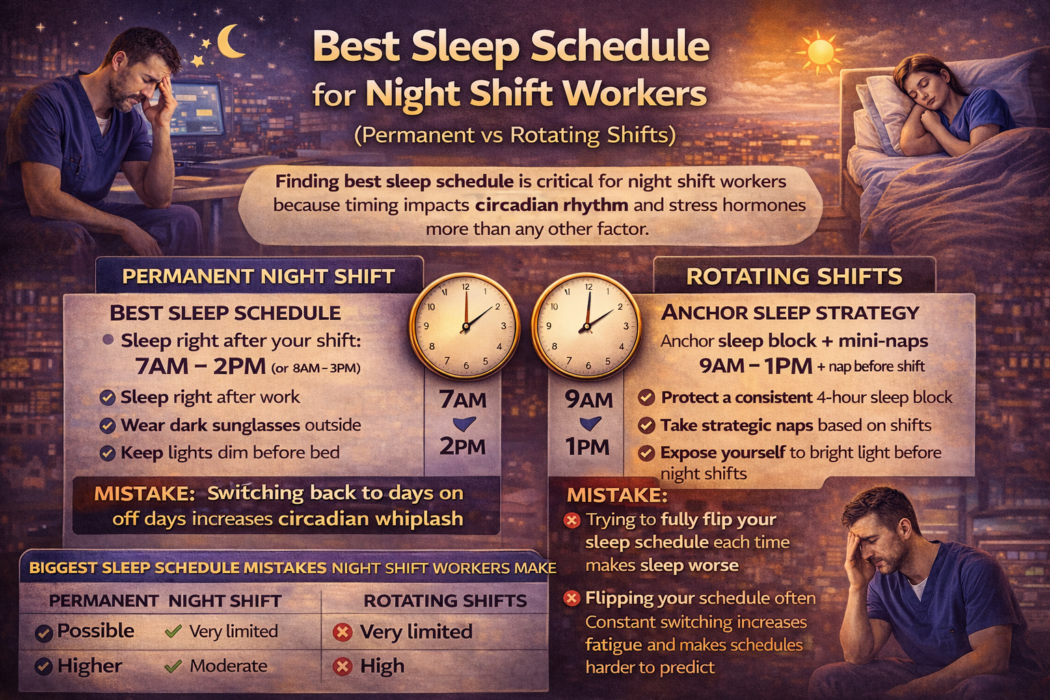
Sample Daily Routines for Night Shift Workers
Developing a practical schedule is crucial for your body to adapt effectively to night shifts. Here’s an example of what a day might look like for permanent night shift workers and rotating shift workers.
Permanent Night Shift Sample Schedule:
– 7:00 AM: Finish night shift
– 7:30 AM: Light meal and wind down
– 8:00 AM: Sleep
– 3:00 PM: Wake up and start the day with a healthy breakfast/lunch
– 4:00 PM: Exercise or engage in physical activity
– 6:00 PM: Family or leisure time with controlled exposure to light
– 8:00 PM: Dinner and relaxation
– 10:00 PM: Prepare for night shift; use bright light to stay alert
Rotating Shift Sample Schedule:
– 6:00 AM: Finish night shift
– 7:00 AM: Short nap (1-2 hours)
– 9:00 AM: Breakfast and exposure to natural light
– 10:00 AM: Free time or errands
– 12:00 Noon: Larger meal
– 1:00 PM: Anchor sleep
– 6:00 PM: Wake up
– 7:00 PM: Light meal/snack
– 9:00 PM: Final preparation for shift
These sample routines illustrate actionable sleep strategies for night shift workers. Next, let’s examine what makes night work so challenging for the body’s sleep systems.
Night shift work doesn’t just reduce sleep — it reprograms sleep timing signals.
It disrupts:
- Melatonin release (sleep hormone)
- Cortisol rhythm (stress hormone)
- Core body temperature cycles
- Hunger and digestion timing
- Sleep pressure buildup
This creates a state similar to chronic jet lag, except there’s no destination where the body fully adapts.
That’s why sleep schedule decisions matter more for night shift workers than almost any other group.
Understanding the difference between permanent night shifts and rotating shifts is crucial for designing your ideal sleep schedule. Let’s clarify how these common shift types impact your sleep.
After understanding the biological impacts, the next key question is how your schedule design shapes these effects.
Before choosing a schedule, you need to know which category you fall into.
Permanent Night Shift
- Same night hours consistently
- Minimal switching between day and night schedules
- Examples: full-time overnight nurses, security, manufacturing
Rotating Shifts
- Alternating between day, evening, and night shifts
- Schedules change weekly or monthly.
- Common in healthcare, emergency services, and transportation
These two situations require very different sleep strategies.
Best Sleep Schedule for Permanent Night Shift Workers
Permanent night shifts give you one major advantage: consistency.
Your goal isn’t to live like a day worker — it’s to create a stable “night-oriented” circadian rhythm.
Ideal Sleep Window for Permanent Night Shifts
Most permanent night shift workers do best with:
- Sleep: 7–9 AM to 2–4 PM
- Core sleep window: at least 4–6 hours at the same time daily
This schedule:
- Avoids peak daylight disruption
- Aligns sleep with natural post-shift fatigue
- Creates predictable melatonin signaling
Why Sleeping Immediately After Work Works Best
Waiting too long after your shift to sleep:
- Exposes you to more daylight
- Elevates cortisol
- Makes sleep lighter and shorter
Think of sleep like momentum — once your shift ends, protect it.
Light Exposure Rules for Permanent Night Shifts
Light is the strongest circadian signal.
After your shift:
- Wear dark sunglasses outside.
- Keep indoor lighting dim.
- Avoid phone use in bed.
Before your shift:
- Use bright light strategically to stay alert.
This helps your brain accept your sleep schedule as “normal.”
Days Off: The #1 Schedule Mistake
Many permanent night workers undermine progress on their days off by reverting to daytime sleep.
This causes:
- Circadian whiplash
- Poor sleep before workdays
- Increased fatigue overall
Better approach: Keep your core sleep window. Allow small adjustments (1-2 hours max) to accommodate important family commitments or social events. For instance, consider shifting your sleep forward or backward slightly for a special occasion, then return to your usual sleep schedule afterward. Avoid full day-night flips.
- Allow small adjustments (1–2 hours max)
- Avoid full day-night flips.
Consistency beats perfection.
👉 Related: 10 Proven Sleep Tips for Shift Workers
Best Sleep Schedule for Rotating Shift Workers
Rotating shifts are significantly harder on sleep, and honesty matters here.
There is no perfect schedule for rotating shifts. The goal is damage control, not optimization.
Why Rotating Shifts Are So Disruptive
Rotating shifts:
- Prevent circadian adaptation
- Constantly reset melatonin timing and increase cortisol variability.
- Increase cortisol variability
- Fragment sleep cycles
The faster the rotation, the worse the impact.
Best Sleep Strategy for Rotating Shifts
Instead of chasing adaptation, aim for:
- A consistent anchor sleep block: Aim for one consistent 4–5-hour sleep block that you protect daily, even if your shift changes.
- Strategic naps: For additional rest, take strategic naps. Ideally, keep your naps to either a short 20–30 minute duration to avoid entering deep sleep, or opt for a longer nap of about 90 minutes to complete a full sleep cycle. The best times to nap are before your night or evening shifts.
- Minimal schedule flipping
Recommended Anchor Sleep Approach
Choose:
- One consistent 4–5 hour sleep block you protect daily
- Add naps around shifts as needed.
Example:
- Anchor sleep: 9 AM–1 PM
- Nap before evening or night shifts
This gives your body some predictability.
Avoid the “Flip Everything” Trap
Trying to fully switch sleep schedules each rotation:
- Increases sleep debt
- Worsens fatigue
- Reduces alertness
Partial consistency is less damaging than full resets.
Permanent vs Rotating Shifts: Side-by-Side Comparison
| Circadian adaptation | Possible | Very limited |
| Sleep consistency | Higher | Lower |
| Fatigue risk | Moderate | High |
| Best strategy | Full night-oriented schedule | Anchor sleep + naps |
| Long-term health impact | Lower | Higher |
Common Sleep Schedule Mistakes Night Shift Workers Make
Mistake #1: Sleeping “Whenever You Can”
Random sleep times confuse the brain and reduce sleep quality.
Mistake #2: Sleeping Too Late Into the Day
Late-day sleep increases sleep grogginess and worsens night alertness.
Mistake #3: Treating Sleep Like a Willpower Problem
Sleep timing is biology, not discipline.
Where Stress Fits Into Sleep Schedules
Even with the right schedule, night shift work elevates stress hormones.
Many workers feel:
- Tired yet wired
- Mentally overstimulated after shifts.
- Unable to fully relax
This is why stress regulation matters as much as scheduling.
One example of a system-based, non-sedating option is Yusleep, which is designed to:
- Support stress regulation. Calm the nervous system.
- Improve sleep regularity without grogginess.
- In addition to supplements like Yusleep, other stress regulation methods can be beneficial. Breathing exercises can quickly help reduce stress and promote relaxation. Consider practicing deep breathing techniques, such as inhaling deeply through your nose, holding your breath for a few seconds, and slowly exhaling through your mouth.
- Meditation is another powerful tool that can help manage stress levels by focusing your mind and promoting inner peace. Even just a few minutes of mindfulness or guided meditation can make a significant difference in stress relief.
👉 See how Yusleep fits into a system-based approach for night shift sleep
How Sleep Schedules Fit Into the Bigger Picture
Sleep schedules are a framework, not the full solution.
Best results come from combining:
- consistent sleep timing timing
- Light management
- Stress regulation
- Strategic naps
- Supportive routines
If you’re new to this topic, start here:
👉 Sleep Tips for Night Shift Workers
If you want a checklist approach:
👉 10 Proven Sleep Tips for Shift Workers
To sum up, what does the best sleep schedule for night shift workers look like in real life?
The best sleep schedule for night shift workers is the one that:
- Reduces circadian conflict
- Minimizes daily decision-making
- Supports recovery, not perfection
- Consistent sleep schedule
For permanent night shifts, consistency is our friend.
For rotating shifts, stability — even partial — is your lifeline.
Sleep won’t be perfect.
But it can be better, more predictable, and less exhausting.