
Why Night Shift Workers Need Different Sleep Aids
If you work nights and struggle to sleep during the day, you’ve probably tried something to help.
Melatonin.
“PM” sleep aids.
Herbal teas.
Alcohol.
Stronger OTC prescription sleep aids out of desperation.
And maybe some of them helped… briefly.
The problem is that night shift sleep problems aren’t caused by a lack of sleep aids. They’re caused by circadian disruption and misalignment of stress hormones.
That means the best natural sleep aid for night shift workers isn’t necessarily the strongest one; it’s the one that works with your biology, not against it. For instance, coordinating the timing of supplements like Yusleep with your intended sleep time can align better with your body’s natural rhythms.
This strategy helps ensure you support your body’s internal clock, making it easier to fall asleep and stay asleep at unconventional hours.
This guide breaks down:
- What actually helps night shift workers sleep
- Which popular sleep aids often backfire
- How to use natural sleep support without making sleep worse
- When a system-based approach makes more sense than single ingredients
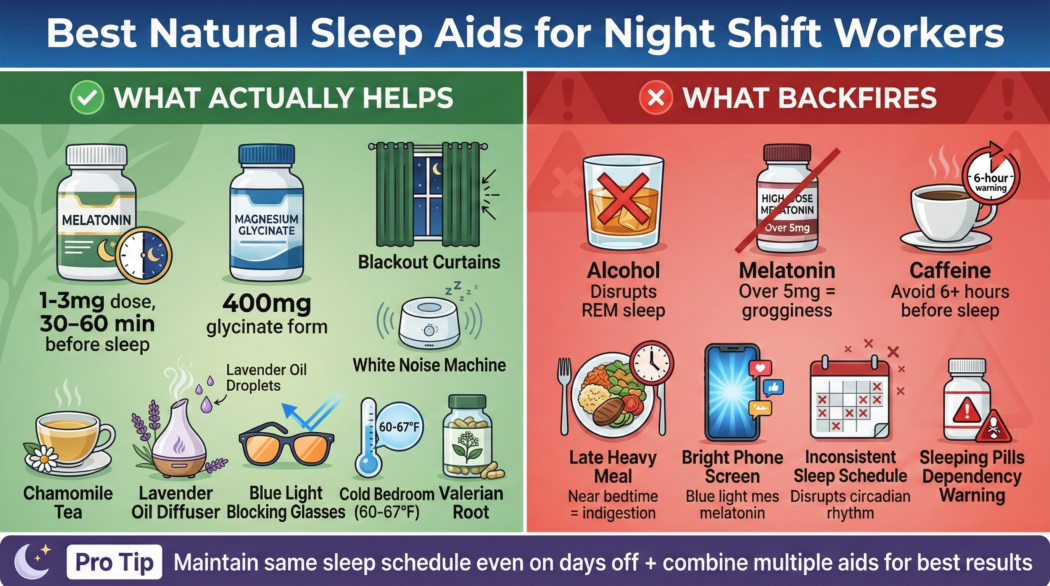
Why Most Sleep Aids Fail Night Shift Workers
Before comparing options, it’s important to understand why many sleep aids disappoint shift workers.
Night shift work disrupts:
- Melatonin timing
- Cortisol (stress hormone) rhythm
- Nervous system balance
- Sleep pressure buildup
Many sleep aids assume:
- Darkness = sleep
- Nighttime = rest
- Cortisol naturally lowers in the evening
- Heavy sedation works for restful sleep
For night shift workers, none of that is true.
That’s why some sleep aids:
- Work once, then stop.
- Trigger sleepiness without better sleep.
- Make daytime sleep lighter or broken.
- Builds a tolerance.
👉 If this sounds familiar, it’s not your fault — it’s timing.
Sleep Aids That Often Backfire for Night Shift Workers
Let’s start with what usually doesn’t work well.
1. High-Dose Melatonin
Melatonin is the most common “natural” sleep aid — and the most misunderstood.
Why it backfires:
- High doses don’t fix circadian timing.
- Can worsen daytime grogginess
- May inhibit your body’s own production
- Often mistimed for night shift sleep.
- Your body becomes tolerant of it, then stops working.
Melatonin is a timing signal, not a sedative. Using it incorrectly can make sleep less predictable.
👉 Related: Circadian Rhythm Disruption and Sleep
2. Sedating Antihistamines (Even “Natural” Ones)
Many over-the-counter sleep aids rely on antihistamine effects.
Problems for night shift workers:
- Reduced REM sleep
- Brain fog after waking
- Increased sleep fragmentation
- Tolerance over time
Sleep drug sedation does not equal a refreshing sleep.
3. Alcohol (Common but Harmful)
Some night shift workers use alcohol to “shut off” after work.
Short-term sedation comes at a cost:
- Suppresses REM sleep
- Increases night wakings
- Disrupts cortisol recovery
- Worsens long-term sleep quality
It often creates a cycle of lighter, less refreshing sleep.
What Actually Helps Night Shift Workers Sleep
Now let’s talk about what does help — when used correctly.
1. Stress-Regulating Support (Not Knockout Sedation)
For night shift workers, the biggest barrier to sleep is often elevated cortisol after work — the “tired but wired” feeling.
Sleep aids that focus on:
- Nervous system calming
- Stress regulation
- Reducing hyperarousal
tend to work better than sedatives.
This is where sleep system-based approaches outperform single ingredients. Supplements should work with your biology and give support for your sleep schedule.
2. Magnesium Glycinate
Magnesium can help:
- Relax muscles
- Calms the nervous system
- Improve sleep quality
Best practices for night shift workers:
- Avoid very high doses.
- Use forms that support relaxation (glycinate, threonate)
- Pair with good light control and sleep timing
Magnesium supports sleep — it doesn’t force it.
3. L-Theanine (For Mental Quiet, Not Sedation)
L-theanine can be helpful for:
- Racing thoughts
- Mental overstimulation
- Stress-related sleep difficulty
It works best when:
- Stress is the main issue.
- Used as part of a routine
- Not relied on as a standalone fix.
Why Multi-Ingredient, Low-Dose Approaches Work Better
One reason night shift workers struggle is that sleep problems aren’t caused by a single factor.
They involve:
- Stress hormones
- Circadian signals
- Nervous system activity
- Your gut health
This is why combining small, complementary supports often works better than maxing out a single ingredient.
One example of this approach is Yusleep, a specially formulated blend of natural supplements designed to support night shift workers. Instead of forcing sleep, Yusleep is designed to:
Instead of forcing sleep, Yusleep is designed to:
- Support stress regulation
- Calm the nervous system.
- Improve sleep consistency
- Avoid next-day grogginess
- All natural
How to Use Natural Sleep Aids Without Making Sleep Worse
Even good sleep aids can fail if used incorrectly.
Rule #1: Timing Matters More Than Dosage
Night shift sleep support should align with your sleep window, not the clock. For example, if you plan to sleep at 8 a.m., taking magnesium 30 minutes beforehand can help prepare your body for rest.
Rule #2: Don’t Stack Too Many Sedatives
Combining multiple sedating aids increases grogginess without improving the quality of sleep.
Rule #3: Support Sleep, Don’t Chase It
Sleep improves when pressure decreases. Over-reliance on sleep aids increases stress.
Best Natural Sleep Aid Strategies for Night Shift Workers
Rather than asking:
“What’s the strongest sleep aid?”
Ask:
“What supports my body’s ability to sleep at the wrong time?”
The best results come from combining:
- Light management
- Steady sleep schedules
- Stress regulation
- Gentle, system-based sleep support
👉 Start here: Sleep Tips for Night Shift Workers
Permanent Night Shifts vs Rotating Shifts: Does This Change the Answer?
Yes.
Permanent Night Shifts
- Benefit more from steady schedules.
- Can partially adapt to sleep timing.
- Respond better to system-based sleep support.
Rotating Shifts
- Require sleep flexibility
- Benefit from stress regulation over sedation. For those working rotating shifts, it’s important to have adaptable sleep routines.
- Consider establishing a pre-sleep ritual you can perform at any time, such as a few minutes of deep breathing or calming music. This can help signal to your body that it’s time to wind down, even if your schedule changes frequently.
- Need lighter, adaptable sleep support.
👉 Related: Best Sleep Schedule for Night Shift Workers (Permanent vs Rotating Shifts
Common Mistakes When Choosing Sleep Aids for Night Shift Work
- Assuming stronger = better
- Ignoring cortisol timing
- Using daytime sleep aids like nighttime ones.
- Chasing instant results
Sleep for night shift workers is a process, not a pill.
How This Fits Into Your Night Shift Sleep System
This article is the decision-making layer of your cluster.
For context:
- Why Sleep Breaks: Cortisol and Night Shift Work
- What schedule to follow: Best Sleep Schedule for Night Shift Workers
- What to avoid: 5 Sleep Mistakes Almost Every Night Shift Worker Makes
Together, these posts create clarity — which drives trust and conversions.
Final Recommendation: What’s the Best Natural Sleep Aid for Night Shift Workers?
The best natural sleep aid for night shift workers is rarely a single ingredient.
It’s an approach that:
- Respects circadian biology
- Calms stress rather than forcing sedation.
- Supports consistency over intensity
When sleep aids work with your system — not against it — sleep becomes:
- More predictable
- Rejuvenating
- Less frustrating
👉 If you want a smarter, system-based option designed around these principles, explore Yusleep here.