
When Melatonin Suddenly “Stops Working”
Melatonin is often the first thing people try when sleep becomes difficult. It works well for many at first, helping them fall asleep faster or reset a disrupted schedule.
Then something frustrating happens.
You keep taking melatonin…
But it doesn’t work.
Or it helps inconsistently.
Or you fall asleep, yet wake up tired.
or it simply doesn’t work anymore…
If that’s your experience, it’s not unusual—and it doesn’t mean melatonin is “bad.” It means melatonin is being used to solve the wrong sleep problem.
Understanding why melatonin stops working is the key to knowing what to use instead.
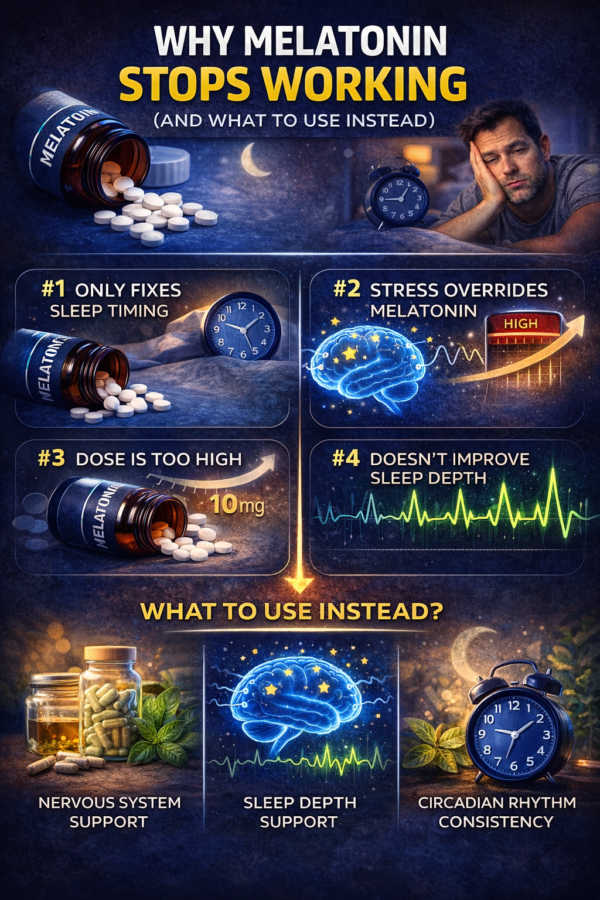
Why Does Melatonin Stop Working?
Before going deeper, let’s address the core question people ask when melatonin fails.
Melatonin often stops working because it does not address the root causes of poor sleep, such as stress, disrupted circadian rhythms, light exposure, or shallow sleep. Over time, relying solely on melatonin can lead to reduced effectiveness as the body’s underlying sleep problems persist.
What Melatonin Actually Does (And What It Doesn’t)
Melatonin is a timing hormone, not a sedative.
Its main role is to:
- Signal that it’s nighttime.
- Help initiate the sleep process.
- Support circadian rhythm alignment.
Melatonin does not:
- Keep you asleep
- Calm an overactive nervous system.
- Fix stress-related sleep fragmentation.
- Improve deep sleep quality on its own
This mismatch is the root of most melatonin failures.
Reason #1: Melatonin Only Helps With Sleep Timing
Melatonin works best when the problem is circadian timing, such as:
- Jet lag
- Shift changes
- Delayed sleep phase
If your main issue is:
- Waking up at night
- Light, shallow sleep
- Stress-driven awakenings
- Feeling tired even after 7–8 hours
Melatonin doesn’t address the real cause.
This is why many people who struggle to sleep but still wake up tired eventually find melatonin ineffective.
Reason #2: Stress Hormones Override Melatonin
Sleep is a balance between:
- Melatonin (sleep signal)
- Cortisol (wake/stress signal)
When stress is high:
- Cortisol rises earlier
- Melatonin signaling becomes weaker.
- Sleep becomes lighter and more fragmented.
This is one reason people wake up tired even after adequate sleep duration, a pattern explained in Why You Wake Up Tired Even After 8 Hours of Sleep.
Melatonin cannot overpower stress chemistry on its own.
Reason #3: The Dose Is Often Too High
Many over-the-counter melatonin supplements contain far more than the body naturally produces.
High doses can:
- Disrupt natural melatonin rhythms.
- Cause next-day grogginess
- Reduce effectiveness over time.
- Lead to early-morning awakenings.
More melatonin does not equal better sleep.
Reason #4: Melatonin Doesn’t Improve Sleep Depth
One of the biggest misconceptions about melatonin is that it creates better sleep.
In reality:
- Melatonin may help you fall asleep.
- But deep, restorative sleep depends on a calm nervous system.
This explains why people say:
“Melatonin helps me fall asleep, but I still wake up exhausted.”
This pattern overlaps heavily with how to sleep longer than 6 hours, where staying asleep—not falling asleep—is the real challenge.
Reason #5: Inconsistent Sleep Schedules Cancel It Out
Melatonin relies on predictability.
When sleep timing changes frequently—especially on days off—melatonin signals become less effective.
This is especially common in:
- Night shift workers
- Rotating schedules
- Weekend sleep “catch-up.”
This same issue shows up in the sleep habit that ruins recovery on night shift, where inconsistency undermines recovery regardless of supplements.
What to Use Instead of Melatonin (Long-Term Solutions)
The key isn’t replacing melatonin with something “stronger.”
It’s supporting the systems melatonin can’t fix.
1. Nervous System Support (Most Important)
If stress, racing thoughts, or tension keep you from sleeping, calming the nervous system matters more than sleep timing.
This includes:
- Supporting relaxation pathways
- Reducing nighttime alertness
- Improving sleep depth
This is why combinations like L-theanine and GABA are often more effective for people with stress-related sleep issues, as the article explains.
2. Sleep Depth Support (Not Just Sleep Onset)
To wake up refreshed, your body needs:
- Continuous sleep
- Fewer micro-awakenings
- Strong deep-sleep cycles
This is especially important if melatonin works but you still feel tired.
😴 Sleeping but not recovering?
Supporting sleep depth—not just sleep timing—is often what makes the difference.
👉 Learn how to support deeper, more restorative sleep naturally.
3. Circadian Rhythm Consistency
Instead of relying on melatonin:
- Anchor sleep and wake times
- Limit schedule swings
- Reduce late-night light exposure.
These changes make your own melatonin work better, without supplementation.
4. Combination Support (When Needed)
Many people do best with:
- Gentle sleep-onset support
- Plus sustained support through the night
This approach is explained in Fast-Acting vs. Sustained-Release: Picking a Natural Sleep Aid for Your Needs, where matching support to the problem matters more than the ingredient itself.
Frequently Asked Questions
Can melatonin stop working over time?
Yes. Melatonin often becomes less effective when it’s used to treat sleep problems related to stress, sleep depth, or schedule inconsistency.
Is melatonin bad for sleep?
Not necessarily. It’s helpful for circadian timing but limited for long-term sleep quality.
Why does melatonin help me fall asleep but not stay asleep?
Because melatonin does not calm the nervous system or improve deep sleep maintenance.
Should I stop taking melatonin?
Many people benefit from reducing or discontinuing melatonin once deeper sleep support and consistency improve.
Conclusion: Melatonin Isn’t Failing—It’s Just Limited
Melatonin doesn’t stop working because your body “gets used to it.”
It stops working because sleep problems are more complex than just sleep timing.
If you’re still waking up tired, restless, or unrefreshed, the solution usually lies in:
- Supporting sleep depth
- Calming the nervous system
- Improving consistency
🌙 Better sleep isn’t about forcing sleep—it’s about supporting recovery.
👉 Explore natural ways to support deeper, more restorative sleep.