
Did you know that over 100 million people worldwide have purchased a Fitbit device? [^1^] This number highlights the enduring popularity and value of these fitness trackers. As we move into 2026, wearable technology continues to evolve rapidly, with new innovations offering more sophisticated ways to monitor health and fitness.
Amid this dynamic environment, the question remains: Is a Fitbit still a worthwhile investment in 2026? This Fitbit Review will explore the latest Fitbit offerings, their features, performance, and help you decide if a Fitbit is right for your wellness journey.
The Evolving World of Fitness Trackers
Before we look at specific Fitbit models, it’s important to understand the broader context. The fitness tracker market is no longer just about counting steps. Today’s devices use advanced sensors and algorithms to provide a holistic view of your well-being.
Features now include advanced sleep tracking, heart rate variability (HRV) analysis, blood oxygen saturation (SpO2) monitoring, ECG, stress management tools, and even health anomaly detection. Competitors like Apple, Samsung, Garmin, and Whoop offer strong alternatives, each with unique strengths.
Fitbit, a pioneer in the industry, has adapted and innovated to maintain its position. Google’s 2021 acquisition brought new resources and integration with Google’s ecosystem, promising enhanced AI and deeper health insights. In 2026, this integration delivers more personalized guidance and uses AI to interpret your data in meaningful ways.
This Fitbit Review also highlights how Fitbit has integrated new technologies for a more comprehensive fitness experience.
Key Fitbit Models in 2026
Fitbit offers a diverse range of devices for different needs and budgets. Here are some prominent models you’ll likely find in 2026:
Fitbit Sense 3
The Fitbit Sense line is Fitbit’s flagship for advanced health monitoring. The Sense 3 continues this, with an impressive suite of sensors:
- ECG App: For on-demand electrocardiogram readings to check for signs of atrial fibrillation (AFib).
- EDA Scan App: Measures your body’s response to stress by tracking electrodermal activity.
- SpO2 Monitoring: Tracks your blood oxygen levels, particularly useful during sleep.
- Skin Temperature Sensor: Monitors variations in your skin temperature, which can indicate changes in your body’s well-being.
- Advanced Sleep Tracking: Detailed insights into sleep stages (light, deep, REM), sleep score, and breathing patterns.
- Built-in GPS: For accurate tracking of outdoor workouts like running and cycling.
- Smartwatch Features: Notifications, contactless payments (Fitbit Pay), voice assistant integration, and a vibrant AMOLED display.
Potential Strengths: Unparalleled health monitoring features, comprehensive data insights, and a sleek design. The integration with Google Assistant is also a significant plus.
Potential Considerations: Premium price point, and some users might find the sheer amount of data overwhelming without a clear understanding of how to act on it.
Fitbit Versa 4
The Fitbit Versa series balances smartwatch functionality and robust fitness tracking. The Versa 4 continues this approach:
- All-Day Activity Tracking: Steps, distance, calories burned, active zone minutes.
- Heart Rate Monitoring: Continuous heart rate tracking and resting heart rate.
- Sleep Tracking: Basic sleep stage tracking and sleep score.
- Built-in GPS: For mapping outdoor activities.
- Smartwatch Features: Notifications, music control, contactless payments.
- SpO2 Monitoring: Available on some models or through Fitbit Premium.
Potential Strengths: A more affordable option than the Sense line, offering a good all-around fitness tracking experience with essential smartwatch features. Excellent battery life is often a hallmark of the Versa series.
Potential Considerations: Lacks some of the advanced health sensors found in the Sense, such as ECG and skin temperature.
Fitbit Charge 6
The Fitbit Charge line is known for its slim, comfortable design and comprehensive tracking, making it a popular choice for everyday wear.
- Advanced Activity Tracking: Steps, distance, calories, active zone minutes.
- Heart Rate Monitoring: Continuous and resting heart rate.
- Sleep Tracking: Sleep stages and sleep score.
- Built-in GPS: For outdoor activities.
- Stress Management Tools: Guided breathing sessions and stress score (often enhanced with Fitbit Premium).
- SpO2 Monitoring: Available on some models.
Potential Strengths: Discreet, lightweight design, long battery life, and a good balance of features for its price. It’s a great option for those who want detailed fitness data without a bulky watch.
Potential Considerations: Smaller screen size compared to the Sense and Versa, which might affect readability for some users. Lacks some of the more advanced health features.
Fitbit Inspire 3
The Fitbit Inspire series is Fitbit’s entry-level option, focusing on core fitness tracking and simplicity.
- Basic Activity Tracking: Steps, distance, calories burned.
- Heart Rate Monitoring: Continuous tracking.
- Sleep Tracking: Basic sleep monitoring.
- Smart Notifications: Alerts for calls and texts.
Potential Strengths: Affordable, lightweight, and user-friendly. Ideal for beginners or those who need basic tracking.
Potential Considerations: Limited features compared to higher-end models, smaller display, and fewer advanced sensors.
Tracking Your Sleep Is Step One — Fixing It Is Step Two
Your Fitbit shows how you’re sleeping — but it doesn’t help you fall asleep faster or stay asleep longer.
That’s where CBN gummies come in.
CBN is widely used for promoting deeper, more restful sleep without grogginess the next day. Many Fitbit users report better sleep scores once they pair tracking with the right nighttime support.
👉 Try the CBN Gummies Sleep Solution Here
Core Features and Performance in 2026
Fitbit’s strength is its comprehensive ecosystem and reliable core features, refined over years. In 2026, these features remain the backbone of the Fitbit experience:
Activity Tracking Accuracy
Fitbit devices are well-regarded for their accuracy in step counting and distance tracking. While no wearable is perfect, Fitbits perform well in this area. Their algorithms differentiate between intentional movement and incidental steps, providing reliable data for daily activity goals.
Built-in GPS on many models ensures accurate mapping and pace tracking for outdoor workouts. Indoor activities like treadmill running or strength training use accelerometer data, which is generally good but less precise than GPS for distance.
Heart Rate Monitoring
Fitbit’s optical heart rate sensors have improved over the years. In 2026, they offer continuous monitoring, providing insights into resting heart rate, exercise heart rate, and heart rate zones. This data is crucial for understanding cardiovascular fitness and optimizing workouts.
Heart Rate Variability (HRV), an indicator of recovery and stress, is also integrated, but it often requires Fitbit Premium for detailed analysis. Accuracy can vary, especially during high-intensity interval training or activities with significant wrist flexion, but for general fitness tracking, they are reliable.
Sleep Tracking
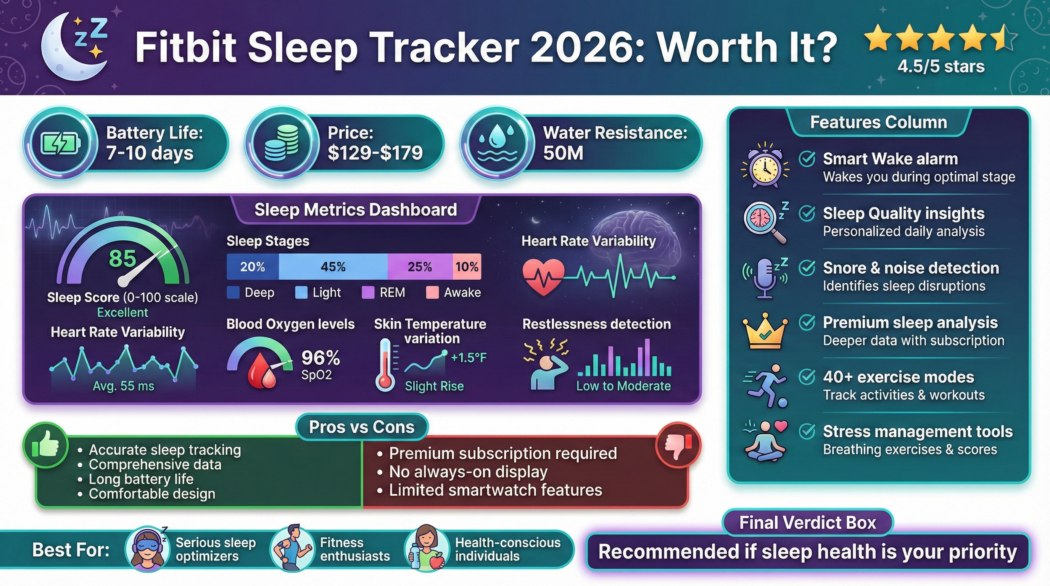
Fitbit has long led in sleep tracking, and the 2026 models continue to excel. They break down sleep into light, deep, and REM stages, providing a Sleep Score to quantify rest quality. Advanced sensors can monitor breathing disturbances, offering insights into potential sleep apnea or other conditions.
The data is presented in an easy-to-understand format in the Fitbit app, helping you identify patterns and improve sleep hygiene. According to the National Sleep Foundation, understanding your sleep stages is crucial for overall health and well-being. [^2^]
SpO2 and Other Health Metrics
Blood oxygen saturation (SpO2) monitoring is now standard on many higher-end Fitbits. This metric provides clues about respiratory health and how well your body absorbs oxygen, especially during sleep. Newer models also include skin-temperature sensing, which can detect subtle changes related to illness, menstrual cycles, or other shifts.
The ECG app on the Sense line is valuable for those concerned about heart health, allowing on-demand checks for signs of AFib. These are not medical devices, but they can provide useful data for discussion with your doctor.
Fitbit Premium: Is It Worth It?
Fitbit’s subscription service, Fitbit Premium, is now central to the Fitbit experience. While core tracking features are available without a subscription, Premium unlocks many additional benefits:
- Personalized Insights and Guidance: Deeper analysis of your health data, with tailored recommendations for exercise, sleep, and stress management.
- Advanced Sleep Tools: More detailed sleep analysis, including trends and comparisons.
- Stress Management Score: A comprehensive score based on your body’s response to stress, with guided programs to help you manage it.
- Workout Programs: Access to guided workouts and training plans.
- Mindfulness Content: Guided meditations and mindfulness exercises.
- Health Reports: Detailed reports that you can share with your doctor.
The Verdict: For users who want to maximize their Fitbit investment and gain a deeper understanding of their health, Fitbit Premium can be valuable. The personalized insights and advanced analytics provide guidance beyond basic tracking.
However, if you’re mainly interested in step counting and basic activity monitoring, the core features may be enough without the subscription. Many new Fitbit devices come with a free trial of Premium, so you can test its features before committing.
Battery Life: A Crucial Factor
One of Fitbit’s main strengths is its impressive battery life. While many competitors’ smartwatches struggle to last a full day, Fitbits typically offer multi-day battery life on a single charge. This is a major advantage for continuous tracking, especially sleep monitoring. In 2026, you can expect:
- Fitbit Sense 3: Typically 4-6 days on a single charge, depending on usage of the always-on display and GPS.
- Fitbit Versa 4: Around 6-8 days, making it a reliable long-term tracker.
- Fitbit Charge 6: Often boasts the longest battery life, reaching up to 7-10 days.
- Fitbit Inspire 3: Can last up to 10 days.
These figures are estimates and may vary based on screen brightness, GPS usage, notification frequency, and the number of apps running. Still, extended battery life remains a key differentiator for Fitbit compared to many feature-rich smartwatches.
The Fitbit App: Your Wellness Hub
The Fitbit app is the hub of your Fitbit experience. It’s where your data is collected, analyzed, and presented. In 2026, the app has become a sophisticated platform:
- Intuitive Dashboard: Easily view your daily stats, progress towards goals, and trends over time.
- Detailed Data Analysis: Dive deep into your sleep stages, activity levels, heart rate patterns, and more.
- Community Features: Connect with friends, participate in challenges, and share your progress for added motivation.
- Food Logging and Water Tracking: Comprehensive tools to monitor your nutrition and hydration.
- Third-Party App Integration: Connect with other health and fitness apps.
The app’s design is user-friendly, making it accessible even for those new to wearable technology. Integration with Google’s services means smoother syncing and potentially more intelligent insights from your data. You can find more about getting started with the Fitbit app and its features on the Fitbit website.
Fitbit vs. The Competition in 2026
Fitbit faces strong competition in 2026. Here’s a brief comparison with some key players:
- Apple Watch: If you’re deeply embedded in the Apple ecosystem and want a full-fledged smartwatch with extensive app support and seamless iPhone integration, the Apple Watch is a strong contender. However, it typically has shorter battery life and a higher price point.
- Samsung Galaxy Watch: For Android users, it offers a compelling alternative with robust health tracking and smartwatch features. It often rivals the Apple Watch in terms of functionality but also shares its limitations in battery life.
- Garmin: Garmin devices are renowned for their advanced GPS, durability, and specialized features for serious athletes and outdoor enthusiasts. They often offer more in-depth training metrics and longer battery life than many smartwatches, but can be more complex to use and less focused on general wellness.
- Whoop: Whoop focuses exclusively on recovery, strain, and sleep, offering a subscription-based model without a screen. It’s geared toward athletes and biohackers who want detailed physiological data but don’t have the smartwatch features of a Fitbit.
Fitbit’s strength is its balance of comprehensive health tracking, user-friendly design, long battery life, and a strong community, all at various price points. It’s a great choice for those who want reliable fitness data and basic smartwatch features without the complexity or cost of a high-end smartwatch.
Is a Fitbit Worth the Investment in 2026?
After reviewing the latest offerings and features, is a Fitbit still worth your money in 2026? As with most technology, it depends.
A Fitbit is likely a good investment if:
- You’re new to fitness tracking: Fitbit offers an accessible entry point with reliable core features.
- You prioritize sleep tracking: Fitbit’s sleep analysis is among the best in the market.
- You want long battery life: Compared to many smartwatches, Fitbits offer significantly longer usage between charges.
- You value a comprehensive health overview: The Sense line, in particular, offers advanced health metrics.
- You want a strong community and motivational tools: The Fitbit app and challenges can be great motivators.
- You are looking for a device with good value for money: Fitbit offers a range of devices to suit different budgets.
A Fitbit might not be the best choice if:
- You need a full-fledged smartwatch with extensive app support: Devices like the Apple Watch or Samsung Galaxy Watch offer a broader app ecosystem.
- You are a serious endurance athlete: Garmin devices often provide more specialized metrics and ruggedness.
- You are solely focused on recovery and performance metrics: Whoop might be a better fit.
- You are on a very tight budget: While Inspire is affordable, some advanced features are locked behind Premium or higher-end devices.
Ultimately, the best way to decide if a Fitbit is right for you is to consider your health and fitness goals, budget, and preferred user experience. You can learn more about starting your fitness journey and exploring wearable options on our Start Here page.
Conclusion
In 2026, Fitbit remains a dominant force in wearable technology. The brand has adapted to the evolving landscape, offering a range of devices with advanced health and fitness tracking. From the comprehensive monitoring of the Sense 3 to the simplicity of the Inspire 3, there’s a Fitbit for nearly everyone. Integration with Google promises more intelligent insights and personalized guidance.
While competition is strong, Fitbit’s focus on user-friendliness, long battery life, and a robust ecosystem ensures its continued relevance. For many, a Fitbit remains a worthwhile investment, providing valuable tools to understand and improve well-being.
Frequently Asked Questions (FAQs)
Q1: How accurate are Fitbit heart rate monitors in 2026?
A1: Fitbit’s optical heart rate monitors are generally very accurate for continuous tracking and moderate-intensity activities. They have been refined over the years and offer reliable data for resting heart rate, heart rate zones, and general activity. However, like most wrist-based optical sensors, accuracy can sometimes dip during very high-intensity interval training or activities that involve significant wrist flexion. For most users, the accuracy is more than sufficient for fitness tracking and general health monitoring.
Q2: Does Fitbit still require a subscription for full functionality?
A2: No, the core functionality of Fitbit devices, such as step counting, distance tracking, continuous heart rate monitoring, and basic sleep tracking, does not require a subscription. However, Fitbit Premium unlocks advanced features like personalized insights, detailed sleep analysis, stress management scores, guided workouts, and health reports. Many new devices come with a free trial of Premium.
Q3: Can I use Fitbit with my iPhone and Android phone?
A3: Yes, Fitbit devices are compatible with both iOS (iPhone) and Android smartphones. You can download the Fitbit app from the Apple App Store or Google Play Store to sync your device and access your data.
Q4: What is the battery life like on the latest Fitbit models?
A4: Fitbit is known for its excellent battery life. In 2026, you can expect most models to last 4 to 10 days on a single charge, depending on the model and usage. This is significantly longer than that of many full-featured smartwatches, making them ideal for continuous tracking, especially of sleep.
Q5: Are Fitbits waterproof?
A5: Most Fitbit devices are water-resistant up to 50 meters (5 ATM), meaning they are suitable for swimming and showering. However, it’s generally recommended to avoid prolonged submersion in saltwater or highly chlorinated water, and to dry the device thoroughly afterward to maintain its longevity.
Q6: Can Fitbit detect serious health conditions like heart attacks?
A6: While Fitbit devices offer advanced health monitoring features like ECG (on Sense models) to detect signs of atrial fibrillation (AFib), they are not medical devices and cannot diagnose serious conditions like heart attacks. The data they provide can be valuable for discussion with a healthcare professional, but they should not be used as a substitute for professional medical advice or diagnosis.
[^1^]: Source: Statista. (Data for wearable device shipments and user base estimations often fluctuates. This figure represents a widely cited cumulative adoption rate.)
[^2^]: Source: National Sleep Foundation. (Information on sleep stages and their importance is widely available on their official website and publications.)
Is Fitbit Worth It? Yes — You Actually Improve Your Sleep and can keep track of it easily
Fitbit is an excellent investment if you use the data to make real changes.
If your sleep score keeps falling short, tracking alone isn’t enough.
That’s why many readers combine Fitbit insights with CBN gummies to relax faster, reduce nighttime restlessness, and wake up feeling more refreshed.
If you’re serious about turning sleep data into better sleep, this is the missing piece.