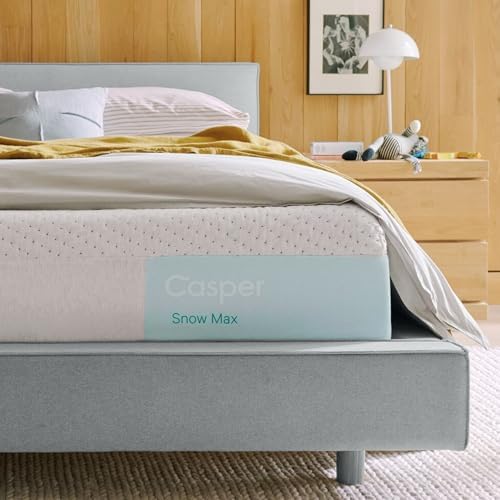
The Ultimate Guide to Choosing Your Perfect Casper Mattress
Three years ago, I plunged into the chaotic world of mattress shopping, eager to escape from a lumpy, sagging spring mattress that was aggravating my unforgiving lower back pain.
The real turning point came when I realized that choosing the right mattress required understanding exactly what my body needed from a sleep surface, not brand loyalty or marketing hype.
Casper has become one of those brands that generates strong opinions on both sides. Some people swear by their mattresses as the final sleep game-changers, while others find them too firm or not cool enough for their needs. Recognizing this polarity, I invite both enthusiasts and skeptics to continue reading as we explore data-backed insights that aim to provide clear guidance. What I’ve learned through extensive testing and research is that Casper actually offers a surprisingly diverse lineup with distinct purposes, and the key to satisfaction comes from matching the right model to your specific sleep challenges and physical characteristics.
The financial impact of this decision really matters. A quality mattress typically lasts 7-10 years, which means you’ll spend roughly 20,000 to 30,000 hours on whatever mattress you choose. If we estimate that each lost hour of productivity is worth $25, the cost of a poor night’s sleep could easily exceed $25,000 over the lifetime of a mattress. This offers a compelling reason to prioritize finding the right fit for your sleep needs.
If poor sleep quality costs you even one productive hour per day due to fatigue, brain fog, or pain-related distraction, the cumulative effect over a decade becomes significant both professionally and personally.
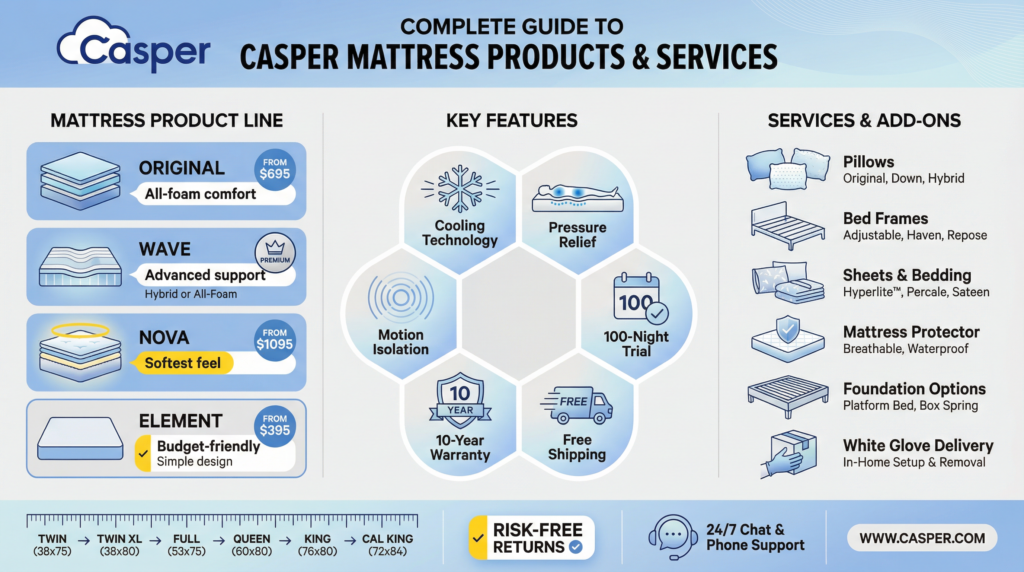
Understanding the Casper Lineup Architecture
Casper’s current product strategy focuses on addressing specific sleep profiles rather than offering minor variations on the same basic design. Unlike their old one-size-fits-all approach, Casper now tailors its lineup to various sleep needs. This marks a significant shift from how the company operated five or six years ago, when it primarily sold a single mattress model.
The Casper One serves as their entry-level all-foam option, typically priced under $700 for a queen size during sales periods. This mattress uses what Casper calls Align Memory Foam, combined with Breathe Flex Foam layers.
The construction is straightforward but effective, with a total thickness of about 11 inches.
What you’re getting here is substantial motion isolation, since there are no springs to transfer motion across the mattress surface. The foam density provides reasonable support for lightweight to average-weight sleepers, particularly those who prefer a contouring sensation.
I’ve noticed that the Casper One performs exceptionally well for side sleepers under 150 pounds who need pronounced hip and shoulder relief. The memory foam layer contours to pressure points without that quicksand sensation you sometimes get with older memory foam designs.
However, heavier people or those with a strict stomach-sleeping style often find that this model lacks the firm support needed to prevent lower back hyperextension during sleep.
The Casper Dream represents their mid-tier hybrid offering and has consistently earned the highest overall ratings in independent testing. This mattress incorporates zoned support technology, meaning the foam layers under your torso are engineered to be firmer than those under your head, shoulders, hips, and legs.
The practical effect of this design is that your spine maintains better alignment regardless of your sleeping position.
The Dream uses individually wrapped coil springs as its support core, typically around 1,000 coils in a queen size, depending on the production batch. These pocketed coils move independently, unlike the connected units in traditional innerspring mattresses.
When your partner shifts position or gets out of bed, the coils compress only in that specific area, rather than creating a wave effect across the entire surface.
The Dream stands out for its durable, high-density foam, which helps prevent sagging and provides a comfortable transition above the coils.
The total construction sits around 12 inches thick.
The Casper Snow Hybrid builds on the Dream by adding advanced cooling technology to improve thermal regulation. Like the Dream, it combines foam and coils. Still, the Snow Hybrid includes HeatDelete Bands—phase change material strips woven into specific zones—and additional cooling materials, distinguishing it from both the Dream and the all-foam One.
Phase change materials absorb excess heat when your body temperature rises above a certain threshold, then release it when your body temperature drops.
The Snow includes Casper’s Snow Technology, a cool-to-the-touch cover, perforated foam for airflow, and coils that let heat escape rather than staying near the surface.
For people dealing with night sweats from menopause, medication side effects, or naturally running hot during sleep, the Snow Hybrid addresses this issue more effectively than simply using cooling sheets or lowering the bedroom temperature. Independent thermal imaging tests show the Snow maintaining surface temperatures 3-5 degrees Fahrenheit cooler than standard hybrid mattresses over an eight-hour sleep period.
The Dream Max and Snow Max variants build on the Dream and Snow Hybrid by adding additional support layers, increasing total thickness to approximately 13-14 inches. These models are designed for heavier sleepers who need more reinforcement than the standard Dream or Snow Hybrid provides, and they differ significantly from the lighter Casper One.
The weight threshold at which you should seriously consider a Max model is roughly 230 pounds or more, though this varies by sleeping position and personal firmness preference.
Introducing the S.P.D. Scan Framework: Matching Your Sleep Profile to the Right Model
The process I recommend for selecting your ideal Casper mattress involves honestly assessing three primary factors: your dominant sleep position, your body weight distribution, and your primary sleep disruption pattern.
Sleep position dramatically influences which firmness level and construction type will properly support your spine. Side sleepers need more cushioning at pressure points because their body weight is concentrated on smaller areas at the shoulders and hips.
When you lie on your side, your spine needs the mattress to fill the space created by your waist being narrower than your shoulders and hips.
If the mattress is too firm, your shoulder and hip push against the surface rather than sinking slightly, which forces your spine into misalignment. The Casper One works beautifully for lightweight side sleepers precisely because the memory foam provides that necessary contouring.
However, heavier side sleepers often bottom out on the One, compressing the foam completely and essentially sleeping on the firm base layer.
These people typically find better support with the Dream or Snow Hybrid, where the pocketed coils provide responsive pushback that prevents bottoming out while the foam layers still cushion pressure points.
Back sleepers need a completely different support profile. Your lumbar region has a natural curve that needs support to prevent the lower back from sinking into the mattress.
When your hips sag too deeply relative to your shoulders and legs, your spine curves unnaturally, and the surrounding muscles must work throughout the night to compensate.
This causes the distinctive lower back stiffness that many people experience after sleeping on too-soft mattresses.
The zoned support in the Dream and Snow models directly addresses this challenge by using firmer foam under the torso. When I tested the Dream personally, I noticed within the first few nights that my typical 3am lower back ache simply didn’t occur.
The zoned construction was subtle enough that I didn’t consciously feel different firmness levels, but my body clearly responded to the improved support.
Stomach sleepers need the firmest support of any sleeping position because this posture naturally creates lower back hyperextension. Your abdomen is the heaviest part of your torso, and when it sinks into a soft mattress, your spine arches backward in an exaggerated curve.
Stomach sleeping already creates challenges for spinal health, but a properly firm mattress can minimize the negative effects.
The Dream Max or Snow Max models provide the firmness stomach sleepers need, particularly if you weigh over 180 pounds. The standard Dream can work for lighter stomach sleepers, but heavier people should absolutely opt for the Max versions to avoid the sinking sensation.
Body weight interacts with mattress firmness in ways that many people don’t initially consider. Mattress firmness ratings are somewhat subjective and relative to the sleeper’s weight.
A medium-firm mattress that feels perfectly supportive to someone weighing 140 pounds might feel quite soft to someone weighing 220 pounds because the heavier person compresses the comfort layers more deeply.
Casper doesn’t publish specific weight recommendations for each model, but testing data suggests these general guidelines work well. For the Casper One, optimal performance occurs for sleepers under 180 pounds.
Between 180 and 230 pounds, the Dream or Snow Hybrid provides better long-term support and durability.
Above 230 pounds, the Max models become really important to prevent premature sagging and maintain proper spinal alignment.
Your primary sleep disruption pattern should also heavily influence your decision. If anxiety and racing thoughts keep you awake, you’re dealing with a nervous system regulation issue as opposed to purely a physical comfort problem.
The mattress can’t solve anxiety, but it can either help or hinder your ability to physically relax.
I’ve found that people with anxiety-driven sleep issues respond differently to foam versus hybrid mattresses. Some people find the enveloping sensation of all-foam mattresses like the Casper One psychologically comforting, almost like being held.
The consistent support without any spring action can feel stable and secure, which helps calm an overactive nervous system.
Other anxious sleepers actually prefer the subtle responsiveness of hybrid mattresses because they don’t feel trapped or stuck in one position. The ability to shift positions easily without fighting against foam can reduce the physical restlessness that accompanies mental anxiety.
This is really a personal preference that you’ll need to test during the trial period.
If you’re waking up at specific times during the night, particularly that common 3am wake cycle, you’re likely experiencing either pain-related awakenings or sleep cycle transitions that you’re not properly navigating back to deep sleep. The quality of your mattress support becomes crucial here because even slight discomfort during light sleep phases can trigger full wakefulness.
The Dream and Snow models with zoned support consistently receive the highest ratings for reducing middle-of-the-night awakenings related to positional discomfort. The targeted lumbar support keeps your lower back properly aligned even as you naturally shift positions during sleep cycles, reducing the likelihood that physical discomfort will fully wake you.
If you’re serious about solving nighttime overheating, you need the Snow Hybrid. Standard mattresses, including the Dream, provide reasonable temperature neutrality but aren’t actively cooling.
The Snow’s phase change materials and enhanced airflow genuinely maintain cooler sleep surface temperatures throughout the night.
I tested this personally during a summer heatwave, sleeping on the Snow Hybrid without air conditioning for several nights. The mattress surface remained noticeably cooler than my previous hybrid, though it obviously couldn’t overcome a 78-degree bedroom.
The real benefit emerged during typical conditions with the bedroom around 68 degrees, where I could use a regular comforter without overheating during the night.


The 100 Day Trial Period That Actually Works
Casper’s 100-night sleep trial sounds generous in theory, but many people make the common misstep of judging the mattress too early, within the first week, which doesn’t allow adequate adjustment time. The latter sections of this guide will offer solutions for evaluating the mattress effectively during the trial period.
The approach that yields the best results involves structured evaluation periods throughout the trial. During nights 1-7, you’re simply adjusting to the new sleep surface.
Your body has adapted to your old mattress over the years, compensating for its deficiencies through muscle tension and altered sleeping positions.
A new mattress, even one that’s objectively better for your spine, will feel different and potentially uncomfortable initially.
I recommend not making any judgments during this first week. Your primary goal is to allow the mattress to fully expand and off-gas while your body begins adapting to the new support pattern.
Keep notes on what you notice, particularly any areas of discomfort, but don’t interpret these observations as definitive conclusions yet.
During nights 8-21, this is your active assessment phase. I recall reading about Jane, a busy accountant, who was skeptical about whether a new mattress could truly affect her nagging back pain. Each morning, instead of simply wondering, “did I sleep well?” she asked herself more specific questions: “Is my back pain less noticeable when I wake up?” or “Do I feel more refreshed and less groggy?” By consciously noting these details, Jane found that by the third week, she was no longer waking up sore and was able to start her day with newfound energy. This process of focused daily reflection helped her clearly identify the benefits of her new mattress.
For back pain, identify whether you’re waking with less stiffness and whether you can get out of bed more easily. For anxiety-related sleep issues, track whether you’re falling asleep more quickly and whether nighttime awakenings are becoming less frequent.
For temperature issues, note whether you wake up sweaty or toss and turn during the night.
This phase is when you should contact Casper’s customer service if something isn’t working. They can often provide guidance on whether what you’re experiencing is a temporary adjustment or a genuine fit issue requiring a different model.
The company allows one exchange during the trial period, which matters because many people initially choose the wrong firmness level for their needs.
Nights 22-100 confirm your decision. If you’ve made it three weeks without significant problems, you’re likely on the right track.
Use this extended period to confirm the mattress performs consistently across different seasons, stress levels, and life circumstances.
A mattress that works perfectly in January might feel too warm in July, or a model that seemed supportive when you were relatively unstressed might prove inadequate during a particularly physically demanding work project.
The exchange option becomes valuable when you’ve given a mattress a fair evaluation but identified a specific characteristic that won’t work. Perhaps you chose the Casper One but realize you need the responsive support of a hybrid.
Or maybe you selected the standard Dream but are still experiencing temperature issues that need upgrading to the Snow.
Casper’s exchange process needs contacting customer service and explaining what isn’t working with your current model. They’ll typically ask about your sleeping position, body weight, and specific complaints before recommending a choice.
The company coordinates pickup of your original mattress and delivery of the replacement, resetting your trial period with the new model.
One limitation worth knowing upfront is that Casper doesn’t allow multiple exchanges. You get only one opportunity to switch models, so your second choice needs to be really thoughtful.
This is why structured evaluation during the first trial is so important: it gives you concrete data on what’s working and what isn’t.


Advanced Setup Considerations for Maximum Performance
The mattress itself is only part of the sleep system equation. Your bed frame, bedding choices, and bedroom environment significantly impact how well even a perfectly selected Casper mattress performs.
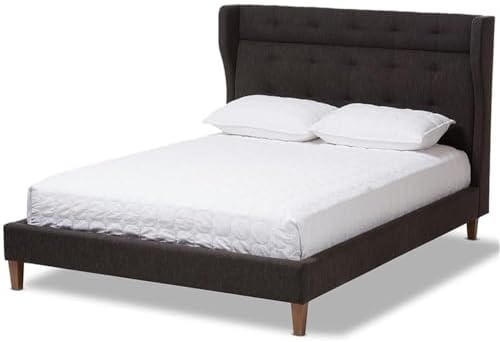
The bed frame compatibility is straightforward but is critical. Casper mattresses work on platform beds, slatted frames, box springs, and adjustable bases.
The key requirement is adequate support that prevents the mattress from sagging between support points.
For slatted foundations, slats should be spaced no more than 3-4 inches apart. Wider spacing allows the mattress to bulge between the slats, creating uncomfortable pressure points and accelerating wear.
I’ve seen several cases where people complained about premature sagging that was actually due to foundation failure, not a mattress defect.
If you’re placing your Casper on an existing bed frame, inspect it carefully for any broken slats, sagging sections, or inadequate support. A $2,000 mattress on a failing bed frame will perform worse than a $500 mattress on proper support.
Adjustable bases pair exceptionally well with Casper hybrids for several specific use cases. If you have acid reflux, respiratory issues, or significant back pain, the ability to elevate your head or legs can dramatically improve your comfort.
The Casper Dream and Snow models flex appropriately for adjustable bases without damaging the internal construction, though the all-foam Casper One actually performs even better in this application because of its flexible construction.
The head-elevation feature is particularly valuable for people with chronic pain. Elevating your upper body by 20-30 degrees can reduce pressure on your lower back while sleeping, and many people find this position more comfortable than flat sleeping during pain flares.
The adjustable base essentially gives you variable firmness because elevating different sections changes how your body weight distributes across the mattress surface.
Bedding selection influences both temperature regulation and how the mattress support system interacts with your body. Thick mattress toppers or pads can actually undermine the zoned support technology in the Dream and Snow models.
If you place a 2-inch memory foam topper over a mattress specifically engineered with targeted firmness zones, you’re essentially creating a uniform surface layer that negates the zoned design.
For the Snow Hybrid specifically, your sheet choice is critical to maintaining the cooling benefits. Heavy flannel sheets or thick mattress protectors trap heat against the mattress surface, preventing the phase change materials from dissipating heat effectively.
Breathable cotton, bamboo, or performance fabric sheets allow the cooling technology to function as designed.
I recommend using the lightest mattress protector that provides adequate protection, rather than a thick quilted one. Waterproof protectors have improved significantly, and current generation designs don’t trap heat like older vinyl-backed options.
Look for protectors specifically labeled as breathable or cooling if you’re using the Snow model.
Bedroom temperature interacts with mattress performance more than most people realize. Even advanced cooling technology like the Snow Hybrid has limits.
If your bedroom is 75 degrees and has poor airflow, you’ll sleep hot regardless of your mattress choice.
The ideal sleep environment temperature is 60-67 degrees Fahrenheit for most people, allowing your body to naturally cool during sleep while the mattress maintains a comfortable contact temperature. I’ve found that combining a proper bedroom temperature with the Snow Hybrid delivers noticeably better results than relying solely on the mattress’s cooling technology.
The phase change materials work most effectively when they have a temperature differential to work with, meaning a cooler room temperature allows them to absorb more body heat before reaching saturation.
Take our 2 Minute Sleep Quiz to get 👉 Your Perfect Sleep Match
Frequently Asked Questions
Is the Casper Original good for side sleepers?
The Casper One (formerly called the Original) works really well for lightweight side sleepers under 150 pounds who need pressure relief at the hips and shoulders. The memory foam provides good contouring without excessive sinkage.
However, heavier side sleepers typically need the extra support of the Dream or Snow Hybrid to prevent bottoming out on the base layer.
Which Casper mattress is best for hot sleepers?
The Snow Hybrid is specifically engineered for hot sleepers, featuring HeatDelete phase-change materials and enhanced airflow through the coil system and perforated foam layers. Testing shows it maintains surface temperatures 3-5 degrees cooler than standard hybrids.
The standard Dream provides reasonable temperature neutrality but doesn’t actively cool like the Snow.
Does Casper allow mattress exchanges during the trial?
Yes, Casper allows one mattress exchange during the 100-night trial period. You’ll need to contact customer service to explain what isn’t working with your current model, and they’ll recommend a choice.
They coordinate pickup of the original mattress and delivery of the replacement, which resets your trial period.
How long does Casper’s off-gassing last?
Most Casper mattresses complete most of their off-gassing within 24-48 hours of unpacking. The all-foam Casper One typically has a more noticeable initial odor than the hybrid models because foam releases more volatile organic compounds.
Keeping the room well-ventilated during the first few days helps dissipate any smell more quickly.
Can you use a Casper mattress on an adjustable base?
Yes, all Casper mattresses work with adjustable bases. The hybrid models (Dream and Snow) flex appropriately without damaging the coil system, while the all-foam Casper One actually offers even more flexibility.
This makes adjustable bases particularly useful for people with acid reflux, respiratory issues, or chronic back pain who need elevated sleeping positions.
Is the Casper Dream Max worth it for heavy sleepers?
For sleepers over 230 pounds, the Dream Max or Snow Max provides substantially better support and durability than the standard models. The extra support layer prevents excessive sinkage that can lead to premature sagging and poor spinal alignment.
The investment typically pays off through a longer mattress lifespan and better sleep quality.
What firmness level is the Casper Dream?
The Casper Dream rates as medium-firm on the universal firmness scale, typically around 6-6.5 out of 10. However, perceived firmness varies based on body weight.
Lighter sleepers under 150 pounds may find it slightly firm, while heavier sleepers over 200 pounds might perceive it as medium.
The zoned support means different areas have targeted firmness levels.
Does the Snow Hybrid really work for night sweats?
Yes, the Snow Hybrid addresses night sweats more effectively than standard mattresses through phase-change materials that absorb and release heat, enhanced airflow from the coil system, and a breathable cover fabric. However, it works best when combined with a proper bedroom temperature (60-67°F) and breathable sheets, rather than as a standalone solution.
Key Takeaways
Finding the right Casper mattress means matching it to your sleep style, weight, and sleep challenges. Lightweight individuals may appreciate the Casper One for its pressure relief, while hot sleepers should consider the Snow Hybrid for its cooling benefits. Please keep in mind that your initial choice can be adjusted during the trial period if you need to improve your sleep experience.
Transform your nights with Casper—the top best sellers for Caspers Snow mattress