If you’re choosing between a Casper and Purple mattress, it can feel overwhelming, especially when both brands promise better support, cooler sleep, and pressure relief. But each mattress works differently—and depending on your body type, sleep position, and pain points, one may be a much better fit than the other.
In this guide, we break down Casper vs. Purple in clear, simple terms: how each mattress is built, who it’s best for, the key benefits, and common complaints from real sleepers. By the end, you’ll know exactly which mattress offers the comfort, support, and value you need for deeper, more restorative sleep.
- Casper mattresses, such as the Casper One, are more affordable, starting at about $799 for a queen. This means you could save roughly 30%–40% upfront with Casper compared to Purple, whose models start at $1,099-$1,499. Casper is a budget-friendly choice that still offers essential features like pressure relief.
- Purple’s GelFlex Grid keeps the mattress cool, making it an excellent pick for hot sleepers. Casper does an okay job, but its all-foam models retain more heat.
- Pressure Relief and Support Are Strong for Both: Both brands offer excellent relief for aches, with Casper’s zoned foams aiding spinal alignment and Purple’s grid reducing pain by up to 40%, though individual preferences vary.
- Casper may feel too firm or not sufficiently bouncy for some people. If you prefer a traditional, firmer sleeping surface, Casper might suit your needs. On the other hand, Purple’s grid has a unique feel that isn’t for everyone. However, if you prefer a pillow-top bounce, Purple’s grid often delivers a responsive feel. Heavier sleepers might notice more sinkage with Purple, so considering your weight and comfort preferences is crucial.
- Best Picks: Choose Casper for value and traditional foam support; opt for Purple if cooling and a responsive, buoyant feel are priorities.
Quick Overview
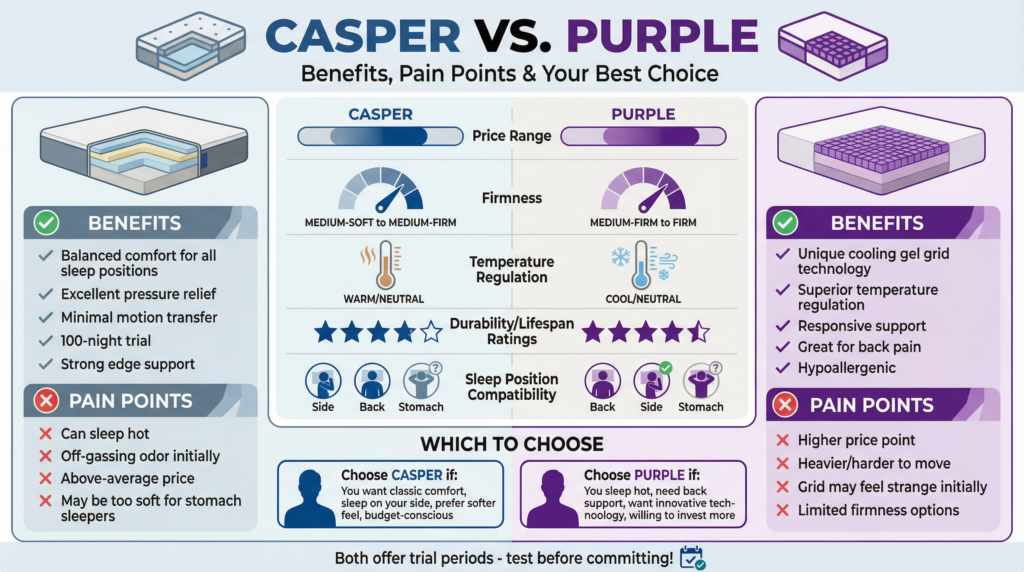
Casper and Purple are well-known bed-in-a-box brands with both foam and hybrid mattresses. Casper uses zoned support for balanced pressure relief, while Purple’s GelFlex Grid gives a unique, adaptive feel. Both offer 100-night trials and 10-year warranties, but they differ in price, cooling, and which sleepers they suit best. If you have back pain or get too hot at night, these mattresses may help, but see a doctor if problems continue.
Key Benefits Comparison
Casper stands out for its lower price and strong spinal support. Its zoned foams lift your lower back and cushion your shoulders, which can help with aches. Casper boasts over a thousand five-star reviews, highlighting customer satisfaction with its comfort and price point. Purple is best for cooling and pressure relief, as its grid lets air flow and eases pain in areas like hips and shoulders. With hundreds of five-star endorsements, readers recognize Purple as a top choice for cooler sleep. Both are good at reducing motion transfer for couples.
Common Pain Points
Casper might sag for heavier people or feel too firm, making it harder to move around. Purple’s grid can feel strange or too soft, which may cause stomach sleepers to be out of alignment. Both have some off-gassing, but it’s more noticeable in Purple hybrids.
The next section gives personal recommendations to help you choose between Casper and Purple based on your needs.
If you want to save money or like a firmer, supportive foam bed for back sleeping, try Casper (like the Casper One). If you sleep hot or want a bouncy feel, Purple (like the Original) is a better fit, but it costs more. Try both brands’ trial periods to see what works for you.
Since launching in 2014 and 2015, Casper and Purple have changed the bed-in-a-box market. Casper made foam mattresses more accessible, while Purple’s GelFlex Grid offers a unique sleep feel. This guide uses expert tests, user reviews, and performance data to show the benefits, like pressure relief and cooling, and the drawbacks, such as edge support and unique feels. Both brands are for people with back pain, overheating, or restless nights, but they differ in how they’re built and who they suit. We’ll look at their main features and performance to help you choose what’s best for you.
Mattress Construction and Design
Casper mattresses, like the Casper One, usually have all-foam builds with zoned polyfoam and memory foam layers. They’re about 11 inches tall and weigh around 69 pounds for a queen. The design has small holes for airflow and a removable cover for easy cleaning. The support is firmer under your lower back and softer at the shoulders, which helps keep your spine straight and eases aches. However, the dense foam can make it harder to move, which may be a problem for people with mobility issues or who change positions often.
Purple’s main feature is its 2-inch GelFlex Grid, made from a stretchy polymer, on top of polyfoam layers. The mattress is 9.5 inches tall and weighs 110 pounds for a queen. The grid has over 1,400 air channels, making it very breathable and great for hot sleepers. Think of the Grid as a hammock for pressure points, adapting to your body to provide a ‘floating’ sensation without sinking. This design not only ensures a comfortable night’s rest but can also reduce pressure points by up to 40%, offering significant pain relief. However, the gel-like feel is unusual and may not be for everyone, and the heavier models are hard to move alone.
Hybrid models from both brands, like the Casper Snow Hybrid and Purple Restore Plus, add coils for more bounce and stronger edges. This makes them more durable, but also more expensive.
Performance Breakdown
Both brands have similar overall scores (Casper 8.41 out of 10, Purple 8.47 out of 10), but each is better in different areas according to lab tests.
Cooling and Temperature Regulation
Purple scores an average of 9.0 out of 10 for cooling, thanks to the Grid’s airflow. This makes it temperature-neutral and a good choice for people with hot flashes or those in warm climates. Some users say they feel “up to 4x cooler” than on other mattresses. Casper averages 8.63 out of 10; its perforations help, but all-foam models like the One (7 out of 10) can still get a bit warm, which isn’t ideal for very hot sleepers. Purple helps prevent sweaty nights, while Casper may need a cooling topper.
Pressure Relief and Pain Management
Both mattresses offer strong pain relief, scoring between 9.0 and 10 out of 10. Casper’s zoned design helps ease lower back and shoulder pain, especially for back sleepers under 130 pounds. Purple’s Grid spreads out your weight and cradles your hips and shoulders, which is great for side sleepers. Some users mention a “floating” feeling without sinking. On the downside, Casper can put pressure on heavier side sleepers, and Purple may cause stomach sleepers over 230 pounds to be out of alignment because it’s softer.
Motion Isolation and Bounce
Both mattresses do well at motion isolation, scoring 8 out of 10, so couples won’t be easily disturbed. Casper’s hybrids are a bit better in this area. Purple is bouncier, with an average bounce of 11.48 inches compared to Casper’s 9.24 inches. This makes it easier to change positions, which is particularly beneficial for older adults who may have mobility concerns or for athletes who value ease of movement. However, softer Purple models may transfer more movement. Purple’s bounce is advantageous for active sleepers, but may not suit light sleepers who are sensitive to movement.
Edge Support and Durability
Edge support is average for both brands. Casper’s hybrids score 9.4 out of 10, and Purple’s Restore Plus scores 9.9 out of 10. All-foam versions are weaker—Purple Original gets just 5.1 out of 10, which can lead to sagging. Both mattresses are durable, but Casper tends to keep its shape longer. The main issue is that the edges aren’t as strong, so you can’t use the full surface as easily.
Off-Gassing and Setup
Purple mattresses can have a stronger smell after unboxing, lasting up to 26 days in some hybrids. Casper’s off-gassing usually lasts 11 to 20 days. Both are easy to set up, but Purple’s heavier weight (110 pounds) can make moving it harder.
| Firmness | Medium Firm (6/10) | Medium to Medium Firm (5–6/10) |
| Price (Queen) | $799–$1,752 | $1,099–$2,079 |
| Cooling Score | 7–8.63/10 | 8–9/10 |
| Pressure Relief | 9–10/10 (Zoned support) | 9–10/10 (Grid cradling) |
| Motion Isolation | 8/10 | 8/10 (Lower in bouncier models) |
| Bounce | 9.24″ average | 11.48″ average |
| Edge Support | 8.9–9.5/10 | 5.1–10/10 (Better in hybrids) |
| Best For | Back sleepers, budget buyers | Hot sleepers, side sleepers |
| Drawbacks | Average cooling, firm for some | Unique feel, higher cost |
Tailored Recommendations
If you’re a new parent or a busy professional, Casper’s motion-isolating foam can help you sleep undisturbed, and its zoned support can ease tension. Purple’s cooling is helpful for menopausal women dealing with hot flashes. For chronic pain, both mattresses can help, but Purple’s grid may relieve pressure points better, while Casper is good for spinal support. Stomach sleepers should skip the softer Purple models, and heavier people may want to look at hybrids from either brand.
Final Thoughts
Casper is a good choice if you want affordable, supportive sleep for daily use. Purple is better if you need top-notch cooling or have issues with overheating. Try both brands’ trial periods, as results may vary by body type. If you have ongoing pain, also focus on good sleep habits.
Casper’s vs Purple Comparison