1. Introduction
Sleepless nights are now a regular problem for millions of adults, not just a rare annoyance. If you are a new parent up several times a night, a shift worker struggling with your body clock, or someone who wants to avoid prescription sleep drugs, finding a real solution can feel overwhelming.
Prescription sleep aids can help in the short term, but worries about dependence, next-day grogginess, and long-term side effects make many people look for other options. The supplement aisle is full of products with big promises, but advice about safety, dosage, and effectiveness often conflicts.
That’s where this guide comes in.
This article explains the best non-habit-forming sleep aids from nature, using science-based criteria to help you choose with confidence. Instead of guessing and wasting money, you will find proven options that support your body’s natural sleep without causing dependence.
If you’re searching for the best natural sleep aid that fits your lifestyle and sleep challenges, you’re in the right place.
👉 Looking for the best natural sleep aid without dependency or grogginess? Scroll down to see the science-backed options that actually support your body’s natural sleep cycle.
2. Evaluation Criteria: How We Chose the Best Options
Not all “natural” sleep aids are created equal. Each product or ingredient featured in this guide was evaluated using the following standards:
✔ Non-Habit Forming
Only ingredients with no evidence of physical dependency or withdrawal effects were considered.
✔ Scientific Support
Human studies, clinical trials, or strong mechanistic evidence were prioritized.
✔ Minimal Next-Day Grogginess
Sleep aids that support sleep quality—not sedation—ranked highest.
✔ Long-Term Safety
Suitable for regular use without disrupting natural sleep cycles.
✔ Real-World Usability
Works for adults with demanding schedules, travel, stress, or disrupted sleep patterns.
These standards make sure every recommendation gives you effective sleep support without long-term problems.
3. Top Picks at a Glance
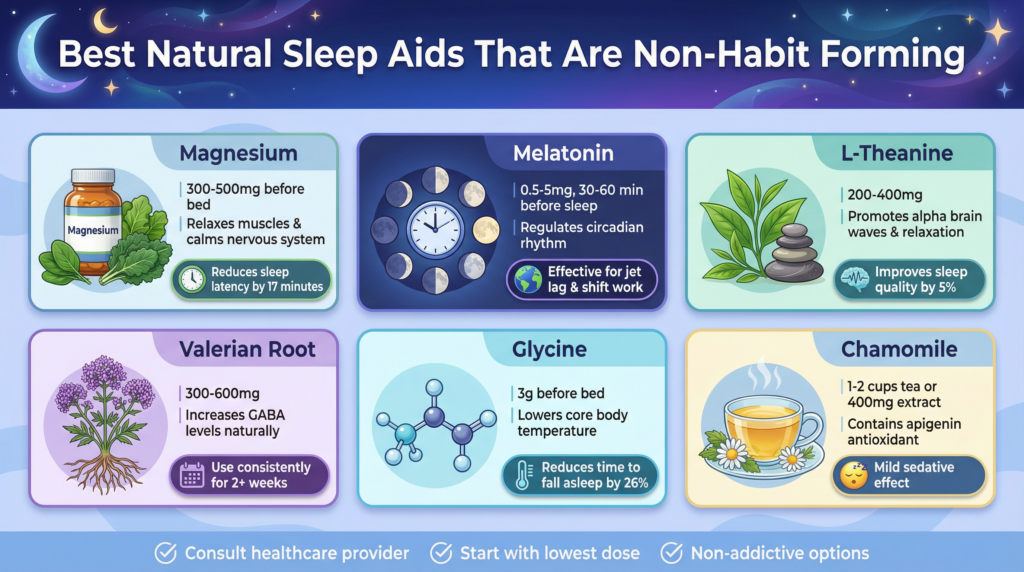
Here are the top non-habit-forming sleep aids from nature, ranked by how well they work, how safe they are, and their overall value:
- Magnesium Glycinate
- L-Theanine
- Ashwagandha (KSM-66® or Sensoril®)
- Glycine
- Low-Dose Melatonin (Micro-dosed)
Each of these options supports sleep through a different biological pathway, which is why no single product works for everyone. See today’s top-rated natural sleep aids. Compare prices, ingredients, and real user reviews before choosing what fits your sleep needs best.
4. Detailed Reviews
1. Magnesium Glycinate – Best Overall for Calm, Deep Sleep
Magnesium plays a role in over 300 body processes, including those that control the nervous system. Magnesium glycinate is easy for the body to absorb and is gentle on digestion.
How it helps sleep:
- Activates GABA receptors (calming neurotransmitter)
- Reduces nighttime muscle tension and restlessness
- Supports deeper, more restorative sleep stages
Best for:
- Adults with stress-related insomnia
- People experiencing nighttime anxiety or muscle tension
- Those prone to leg cramps or restless sleep
Typical dose: 200–400 mg, taken 1–2 hours before bed
👉 Check current prices and verified reviews for this sleep aid. Make sure you’re getting a clinically dosed, third-party tested product. Many people consider this the best natural sleep aid if you have trouble turning off your thoughts at night.
2. L-Theanine – Best for Racing Thoughts
L-Theanine is an amino acid found in green tea. It helps you feel relaxed and alert without making you sleepy.
How it helps sleep:
- Increases alpha brain waves
- Reduces mental chatter and stress
- Improves sleep quality without forcing drowsiness
Best for:
- Overthinkers
- Professionals with high cognitive load
- Parents whose minds race after kids are asleep
Typical dose: 100–200 mg before bedtime
👉 Not sure which option is right for you?. Browse trusted natural sleep aids and choose based on your sleep issue, budget, and lifestyle.
L-Theanine works especially well with magnesium for a calming bedtime routine.
3. Ashwagandha – Best for Stress-Driven Insomnia
Ashwagandha is an adaptogenic herb that helps regulate cortisol, your body’s main stress hormone. It helps sleep:
- Lowers evening cortisol levels
- Improves sleep onset and duration
- Supports nervous system balance over time
Clinical trials using standardized extracts (KSM-66® or Sensoril®) show improved sleep quality after 6–8 weeks.
Best for:
- Chronic stress sufferers
- Caregivers and new parents
- Adults with “wired but tired” fatigue
Typical dose: 300–600 mg daily
👉 Explore the best natural sleep aids trusted by thousands of users. Find a non-habit-forming option that supports more profound, more restorative sleep—without trial and error. For stress-related sleep disruption, this is a strong contender for the best natural sleep aid in the long term.
4. Glycine – Best for Improving Sleep Quality
Glycine is an amino acid that helps lower your core body temperature, which signals your body that it’s time to sleep.
How it helps sleep:
- Improves sleep efficiency
- Reduces next-day fatigue
- Enhances REM sleep quality
Best for:
- People who sleep but don’t feel rested
- Frequent travelers
- Older adults with fragmented sleep
Typical dose: 3 grams before bedtime
Glycine works gently but can be very effective if you use it regularly.
5. Low-Dose Melatonin – Best for Circadian Rhythm Reset
Melatonin is often used incorrectly. High doses can make you groggy and affect your body’s natural melatonin. Taking a small dose (0.3–1 mg) matches what your body naturally makes.
How it helps sleep:
- Resets circadian rhythm
- Improves sleep timing (not sedation)
- Helpful for jet lag and shift work
Best for:
- Shift workers
- Frequent travelers
- Adults over 40 with declining melatonin production
Typical dose: 0.3–1 mg, 2 hours before bed
When used the right way, this can be a helpful natural sleep aid for fixing sleep timing, not for making you sleepy every night.
5. Comparison Table
| Magnesium Glycinate | Stress, muscle tension | ✅ Yes | Very Low | ✅ Safe |
| L-Theanine | Racing thoughts | ✅ Yes | None | ✅ Safe |
| Ashwagandha | Cortisol imbalance | ✅ Yes | Low | ✅ Safe |
| Glycine | Sleep quality | ✅ Yes | None | ✅ Safe |
| Low-Dose Melatonin | Circadian rhythm | ✅ Yes (low dose) | Low if overdosed | ⚠ Use strategically |
6. Buying Guide: How to Choose the Right Sleep Aid
Match the Aid to the Problem
- Stress/anxiety → Magnesium or Ashwagandha
- Racing thoughts → L-Theanine
- Poor sleep quality → Glycine
- Schedule disruption → Low-dose melatonin
Avoid Proprietary Blends
These hide dosages and often underdose key ingredients.
Third-Party Testing Matters
Look for NSF, USP, or GMP certifications.
Start Low
Even natural supplements can be too strong at high doses.
Not sure which option is right for you? Browse trusted natural sleep aids and choose based on your sleep issue, budget, and lifestyle.
Choosing the best natural sleep aid means picking what fits your needs, not taking everything at once.
👉 If anxiety is what keeps you awake, calming techniques like mental reset methods may be just as important as natural supplements.
7. Final Thoughts
There is no single cure for sleep problems, but there are safe and effective tools that work with your body. The best natural sleep aid is the one that matches your specific sleep issue, whether it’s stress, a disrupted body clock, or poor sleep quality.
The options in this guide are:
- Non-habit forming
- Backed by science
- Suitable for long-term use
If you are unsure about using prescription sleep medications or are frustrated by supplements that do not help, these natural options offer a safer and smarter way forward.
👉 Explore the best natural sleep aids trusted by thousands of users. Find a non-habit-forming option that supports deeper, more restorative sleep—without trial and error. You do not need to depend on anything to sleep better. You just need the right knowledge and support.