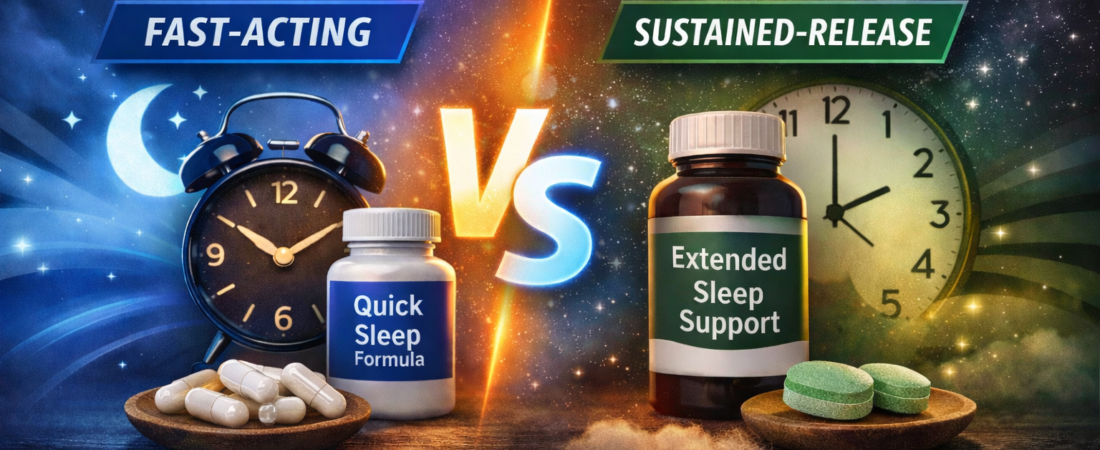
Finding a natural sleep aid that works without grogginess, dependency, or diminishing sleep quality can feel overwhelming. Walk into any store, and you’ll see labels promising “fast sleep,” “all-night support,” “maximum strength,” or “timed release.”
But here’s the truth most people never hear or see in the store.
The problem isn’t which ingredient you choose — it’s whether the sleep aid matches how your sleep breaks down and what is needed to fix it.
- Some people struggle to fall asleep.
- Others fall asleep easily but wake up too early or too often.
- Some people work night shifts and struggle to fall asleep after work.
- Chronic insomnia can affect people’s sleep in the long term.
- Many experience both, depending on stress, schedules, or hormones.
That’s where the difference between fast-acting and sustained-release sleep aids becomes critical.
Let’s look at how fast-acting and sustained-release options work, who benefits most from each type, and how to pick the right natural sleep aid based on your particular sleep pattern.
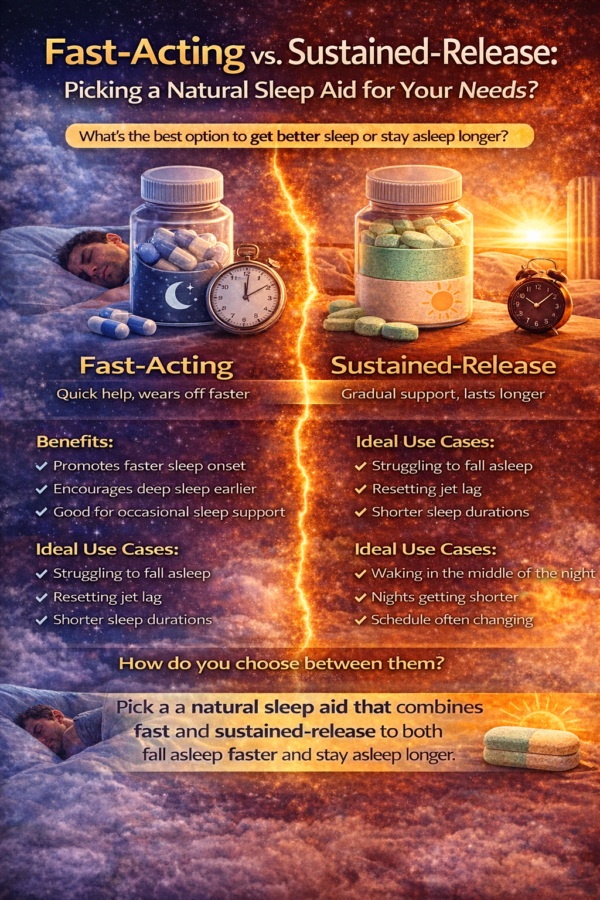
Fast-Acting vs. Sustained-Release Sleep Aids (Comparison Chart)
| Feature | Fast-Acting Sleep Aids | Sustained-Release Sleep Aids |
|---|---|---|
| Primary purpose | Help you fall asleep faster | Help you stay asleep longer |
| How they work | Rapid absorption for quick calming | Gradual release over several hours |
| Onset time | 15–45 minutes | 1–2 hours (steady build) |
| Duration of effect | Short (2–4 hours) | Long (6–8+ hours) |
| Best for | Racing mind, stress at bedtime | Night awakenings, early wake-ups |
| Sleep stage support | Mainly sleep onset | Deeper, more continuous sleep |
| Common ingredients | L-theanine, GABA, valerian, lemon balm | Extended-release melatonin, magnesium glycinate, slow-release botanicals |
| Risk of waking too early | Higher | Lower |
| Next-day grogginess | Low (when properly dosed) | Low to moderate (depends on formula) |
| Ideal timing | 30–60 minutes before bed | 1–2 hours before bed |
| Works well with night shift? | Yes (for falling asleep after shifts) | Yes (for staying asleep during daytime) |
| Typical use case | Trouble shutting off the brain | Sleep fragmentation or short sleep duration |
How to Choose the Right Option (Quick Guide)
- Choose fast-acting if you:
- Lie awake with a busy mind
- Feel stressed or wired at bedtime
- Fall asleep slowly but sleep okay once out
- Choose sustained-release if you:
- Wake up after 4–6 hours
- Have light, broken sleep
- Wake too early and can’t fall back asleep
- Consider a combination if you:
- Struggle to fall asleep and stay asleep
- Work night or rotating shifts
- Experience stress-related sleep disruption
What “Fast-Acting” and “Sustained-Release” Really Mean
Sleep aids are commonly grouped by how quickly they work and how long they last — not just by ingredients.
Fast-Acting Sleep Aids
Designed to:
- Work quickly (15–45 minutes)
- Calm the nervous system.
- Help initiate sleep
They’re commonly used by people who:
- Feel wired at bedtime
- Have racing thoughts
- Struggle with sleep onset anxiety
Sustained-Release Sleep Aids
Designed to:
- Release ingredients slowly over hours.
- Support sleep maintenance
- Reduce early awakenings
They’re often used by people who:
- Wake up at 2–4am
- Experience light, interrupted sleep
- Feel unrested despite sleeping “long enough.”
Instead of simply choosing one or the other, consider where your sleep typically falters. This will determine your best fit.
Feature Comparison: Fast-Acting vs. Sustained-Release
How Fast-Acting Sleep Aids Work
Fast-acting formulas typically focus on:
- Nervous system calming
- Reducing stress signals
- Short-term sedation effects
Common ingredients include:
- L-theanine
- Magnesium glycinate
- GABA
- Certain herbal extracts
Strengths
- Helpful for falling asleep faster
- Useful during acute stress
- Lower risk of morning grogginess (when dosed correctly)
Limitations
- Effects may wear off during the night.
- Not ideal for sleep maintenance issues
- Can feel inconsistent during high-stress periods
How Sustained-Release Sleep Aids Work
Sustained-release formulas aim to:
- Preserve balanced sleep chemistry.
- Prevent cortisol spikes overnight.
- Support deeper sleep cycles.
They frequently depend on on:
- Time-released nutrients
- Layered ingredient delivery
- Longer absorption curves
Strengths
- Better for staying asleep
- Helpful for early morning wake-ups
- More consistent overnight support
Limitations
- Slower onset
- It can cause morning grogginess if poorly formulated.
- Not ideal if falling asleep is the main problem.
Performance Analysis: What Actually Works in Real Life
If You Can’t Fall Asleep
Fast-acting support tends to work better when:
- Stress is the primary driver.
- Your mind won’t shut off.
- Sleep anxiety is present.
Many people find that forced sedation can lead to rebound wakefulness later.
👉 Related guide: Why Sleep Aids Stop Working (And What Actually Helps)
If You Fall Asleep but Wake Up Too Early
Sustained-release approaches are often more helpful when:
- Sleep breaks down after a few hours.
- Cortisol rises too early.
- Sleep feels shallow or interrupted..
Using sustained release without calming stress signals first can still fail.
👉 Related guide: Why You Wake Up at the Same Time Every Night
When Both Problems Exist (Most Common)
This is where single-ingredient or single-timing approaches often fail.
Many chronic sleepers:
- Need help calming down initially.
- AND need support staying asleep
This is why multi-layered, sleep-quality-first formulas tend to outperform single-release products over time.
Price Comparison: What Are You Actually Paying For?
Fast-Acting Products
- Often cheaper upfront
- Widely available
- Lower manufacturing complexity
But cost can add up due to:
- Inconsistent results
- Trial-and-error buying
- Needing multiple products
Sustained-Release Products
- Typically higher priced
- More complex formulations
- Better suited for chronic issues
However, poorly designed sustained-release products often:
- Over-sedate
- Create next-day fog
- Lose effectiveness over time.
Price alone doesn’t equal value. Formulation strategy does.
Best For Different Users
Best Fit: Fast-Acting
- Stress-driven insomnia
- Occasional sleeplessness
- Travel or schedule disruption
- Sleep onset anxiety
Best Fit: Sustained-Release
- Early morning wake-ups
- optimized sleep
- Hormone-driven disruptions
- Non-restorative sleep
Best Fit: Combined or Layered Support
- Chronic insomnia
- Night shift or irregular schedules
- “Tired but wired” patterns
- Sleep aids that stopped working.
👉 Related guide: How to Get Quality Sleep (What Actually Works vs. What Backfires)
Where Many Sleep Aids Go Wrong
Common mistakes include:
- Treating sleep as a sedation problem
- Ignoring stress hormones
- Using higher doses instead of better timing
- Chasing faster effects instead of deeper sleep
Sleep improves most when the body feels safe enough to stay asleep, not just when it is knocked out.
How Yusleep Fits Into This Comparison
Many people don’t need stronger sleep aids — they need better-designed support.
Yusleep is built around:
- Supporting sleep quality over sedation
- Calming stress signals
- Helping sleep stay stable through the night.
- Avoiding the “works at first, then fails” cycle.
Instead of choosing between fast-acting and sustained-release, it focuses on balanced, layered support that better aligns with how sleep works.
👉 See how Yusleep supports deeper, more uninterrupted sleep and absorbs the fastest
Final Recommendation: How to Choose the Right Approach
There is no single “best” sleep aid for everyone.
The best choice depends on:
- Where your sleep breaks down
- Whether stress or timing is the driver
- How sensitive are you to sedation?
- Whether your sleep problem is occasional or chronic
For many people, the best natural sleep aid isn’t the fastest or strongest — it’s the one that supports calm, stable, restorative sleep without forcing the body.
If you’ve tried fast-acting products that wear off, or sustained-release formulas that leave you foggy, a sleep-quality-first approach may be the missing piece.