
Introduction
For millions of people struggling with insomnia, sleep problems are commonly described as a melatonin issue. Yet research increasingly suggests that many cases of persistent insomnia are not caused by low melatonin, but by insufficient GABAergic signaling in the brain.
Facilitating the transition to Gamma-aminobutyric acid (GABA) is the brain’s primary inhibitory neurotransmitter. It plays a central role in calming neural activity, reducing stress responses, and facilitating the transition to sleep. When GABA signaling is impaired, the brain remains hyper-aroused, making it difficult to fall asleep, stay asleep, or reach deep, restorative phases of sleep.
Understanding how GABA regulates sleep provides critical insight into why common sleep aids fail—and why approaches that support nervous system balance may be more effective than sedatives or hormone supplementation.
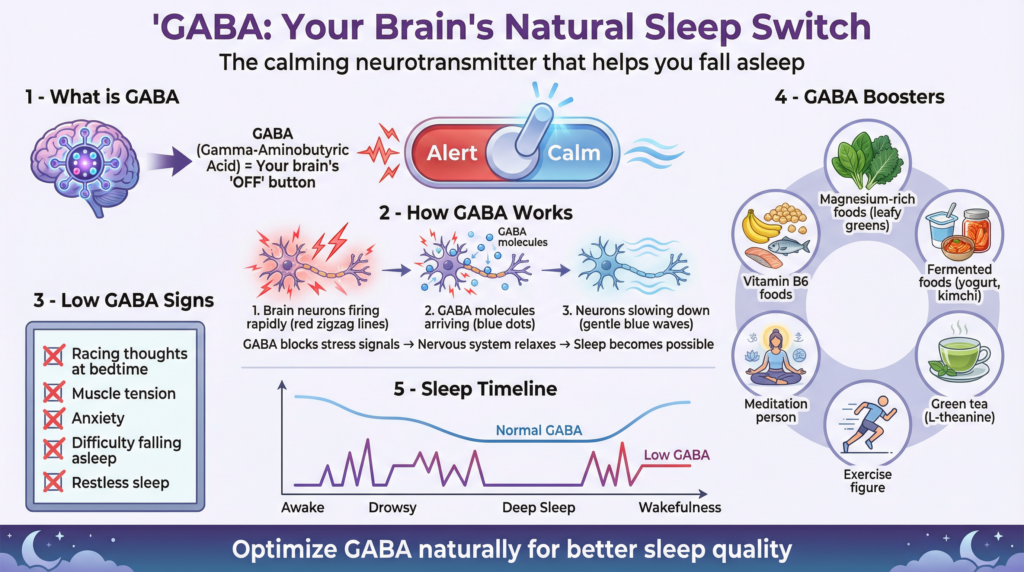
What Is GABA?
What does GABA do in the brain?
GABA (gamma-aminobutyric acid) is an inhibitory neurotransmitter that reduces nerve cell activity. It counterbalances excitatory chemical messengers like glutamate, helping regulate stress, anxiety, and sleep onset.
In healthy sleep physiology, rising GABA activity in the evening:
- Suppresses wake-promoting neurons
- Calms cortical activity
- Facilitates the transition from being awake to sleep
Low or dysregulated GABA signaling is strongly associated with insomnia, anxiety-related sleep disturbance, and difficulty achieving deep sleep.
GABA’s Role in Sleep Architecture
Sleep is not a passive process. It requires the coordinated downregulation of arousal systems. GABA plays a essential function during this process by inhibiting activity in:
- The reticular activating system
- The hypothalamic wake centers
- Stress-responsive limbic regions
How GABA Supports Each Sleep Stage
- Sleep onset (N1/N2): GABA suppresses alertness and racing thoughts
- Deep sleep (N3): Stable GABA signaling supports slow-wave activity
- REM regulation: GABA balances REM timing and prevents fragmentation
When GABA activity is insufficient, the brain has difficulty to disengage from being awake—even in the presence of sleep pressure.
Why Many Insomniacs Are GABA-Deficient
Chronic insomnia is often associated with hyperarousal, a state in which the nervous system remains activated at night. This state is closely tied to impaired GABA signaling.
Common Causes of Low GABA Activity
- Chronic stress and elevated cortisol
- Anxiety and rumination
- Inflammation and neuroimmune activation
- Gut microbiome imbalance
- Sleep deprivation itself (feedback loop)
Research supported by the National Institutes of Health (NIH) shows that chronic stress reduces GABA receptor responsiveness, making it harder for the brain to respond to inhibitory signals—even when GABA is present.
Stress, Cortisol, and GABA Suppression
Stress hormones directly interfere with GABA function. Elevated cortisol:
- Reduces GABA receptor responsiveness
- Increases glutamate-driven excitation
- Promotes nighttime alertness
This explains why many people feel “wired but tired”—exhausted during the day, yet unable to relax at night.
As discussed in our article on cortisol, stress, and sleep disruption, restoring sleep often requires calming the stress response—not forcing sleep chemically.
The Gut–GABA–Sleep Connection
The gut microbiome plays a surprisingly important role in GABA production and regulation. Certain gut bacteria can produce GABA directly, while others influence its synthesis and receptor activity.
Gut Factors That Influence GABA
- Microbial diversity
- Short-chain fatty acid (SCFA) production
- Intestinal barrier integrity
- Inflammatory signaling
Disruptions in gut health can reduce GABA availability and increase systemic inflammation—both of which impair sleep control.
This pathway is explored in greater depth in our pillar guide on gut health and sleep control, which examines how microbial balance influences neurotransmitters and circadian rhythm.
Why Melatonin Alone Often Fails (Featured Snippet Section)
Why doesn’t melatonin work for everyone?
Melatonin signals when to sleep, but it does not calm neural activity. If GABA signaling is impaired, melatonin may increase sleepiness without enabling the brain to shut down arousal systems.
This is why many people experience:
- Drowsiness without sleep
- Vivid dreams but shallow rest
- Tolerance with repeated melatonin use
Melatonin works best when the nervous system is already capable of relaxation—something that depends heavily on GABA.
See also: Why Melatonin Stops Working: Tolerance, Timing, and Gut Health.
GABA vs Sedatives: An Important Distinction
Prescription sleep medications commonly target GABA receptors indirectly, but they do so in a way that overrides natural sleep physiology.
Key Differences
| Supports natural inhibitory signaling | Forces sedation |
| Preserves sleep architecture | Reduces deep sleep |
| Non-habit forming | Risk of dependence |
| Works with circadian rhythm | Can disrupt REM |
This distinction matters because sedative sleep is not the same as refreshing sleep.
Inflammation, GABA, and Sleep Quality
Chronic inflammation suppresses GABAergic tone by:
- Increasing excitatory neurotransmission
- Reducing receptor responsiveness
- Activating stress pathways
As covered in Inflammation and Sleep: How Chronic Inflammation Disrupts Deep Sleep, inflammatory signaling shifts the brain toward vigilance rather than rest.
Reducing inflammation and supporting GABA are complementary—not competing—strategies for improving sleep quality.
When to Consider Targeted GABA-Supportive Sleep Solutions
You may benefit from GABA-supportive sleep strategies if you experience:
- Racing thoughts at bedtime
- Anxiety-driven insomnia
- Frequent night awakenings
- Poor deep sleep despite long sleep duration
- Limited response to melatonin
In these cases, approaches that support nervous system regulation and parasympathetic activity may be more effective than hormone supplementation alone.
When sleep problems are driven by stress and nervous system hyperarousal, calming inhibitory pathways are often more effective than sedating the brain. We reviewed Yu Sleep through the lens of GABA signaling, stress physiology, and actual sleep recovery data.
Supporting GABA Naturally
While no single intervention “fixes” GABA imbalance, several lifestyle and nutritional factors support healthy GABAergic function:
- Stress reduction and nervous system regulation
- Anti-inflammatory diet patterns
- Gut microbiome support
- Consistent circadian cues (light, meals, sleep timing)
These essential components c create the conditions under which GABA signaling can normalize.
Frequently Asked Questions (FAQ)
What is GABA, and why is it important for sleep?
GABA is the brain’s primary calming neurotransmitter. It reduces neural activity, allowing the nervous system to shift into sleep..
Can low GABA cause insomnia?
Yes. Low GABA activity is strongly associated with hyperarousal, anxiety-related insomnia, and difficulty staying asleep.
Does melatonin increase GABA?
Melatonin and GABA work together, but melatonin does not directly increase GABA signaling. Adequate GABA is required for melatonin to be effective.
Can gut health affect GABA?
Yes. Certain gut bacteria influence GABA production and receptor responsiveness, linking gut health to sleep quality.
Is supporting GABA the same as taking sleeping pills?
No. Supporting GABA aims to restore neural balance and natural inhibitory signaling, whereas sleeping pills override the physiology of sleep.
What type of insomnia is most linked to GABA dysfunction?
Stress-related insomnia, anxiety-driven sleep onset problems, and interrupted sleep are most closely linked to impaired GABA signaling.
Final Thoughts
GABA is a fundamental yet frequently overlooked regulator of sleep. For many insomniacs, the problem is not a lack of sleep drive—but a nervous system that cannot disengage from alertness.
Comprehending how GABA interacts with stress, inflammation, gut health, and circadian rhythm, a clearer picture of sleep control emerges—one that explains why melatonin alone is inadequate.
Addressing sleep through the lens of nervous system balance rather than sedation opens the door to deeper, refreshing sleep.
GABA doesn’t make you sleep — it allows your brain to feel safe enough to rest.
When GABA signaling is low or disrupted, the nervous system stays in a state of alertness, even when you’re exhausted. This is why many people struggle with racing thoughts, light sleep, or frequent night wakings. To learn how nervous system regulation, circadian rhythm alignment, and biological balance work together to restore deep, consistent sleep naturally.