Why Shift Work Disrupts Sleep So Dramatically
If you work nights, rotating shifts, or early mornings and feel tired or mentally foggy, discipline isn’t the issue.
It’s biology.
Shift work directly interferes with your circadian rhythm, the internal 24 hour clock that controls:
- When you feel sleepy or alert
- Melatonin and cortisol release
- Deep sleep and REM sleep cycles
- Mood, focus, and metabolism
Your brain evolved to sleep at night and wake with daylight. When you fight your natural rhythm, your nervous system stays chronically misaligned and cortisol is unbalanced.
That’s why night shift workers experience:
- Difficulty falling asleep even when exhausted
- Light, interrupted sleep
- Elevated anxiety and irritability
- Poor REM sleep and mental fatigue
- Zombie like state
- High cortisol levels after work in the morning
Understanding this sleep problem is the first step toward fixing it.
🎥 Watch This First
If you work night shifts or rotating schedules and feel exhausted no matter how much you sleep, this isn’t your fault. This short video explains why shift work disrupts sleep so deeply — and why it requires a completely different approach than standard sleep advice.
To help you navigate these challenges, here are 10 Proven Sleep Tips for Night Shift Workers.
🌙 Shift work creates a different kind of sleep problem — and it needs a different solution.
Below, you’ll find proven, realistic sleep strategies designed specifically for night shift workers to protect their circadian rhythm, improve deep sleep and REM sleep, and restore energy over time.
Shift Work and Circadian Misalignment (The Real Problem)
Your circadian rhythm relies on external cues:
- Light
- Darkness
- Meal timing
- Movement
- Steady habits
To help combat these issues, consider implementing these 10 Proven Sleep Tips for Night Shift Workers.
Shift work scrambles these prompts.
This causes circadian desynchronization—your brain and body follow different clocks.
This affects:
- Deep sleep (physical restoration)
- REM sleep (mental recovery)
- Cortisol hormone balance
- Immune function
- Focus
The goal is to focus on minimizing disruption and building better habits.
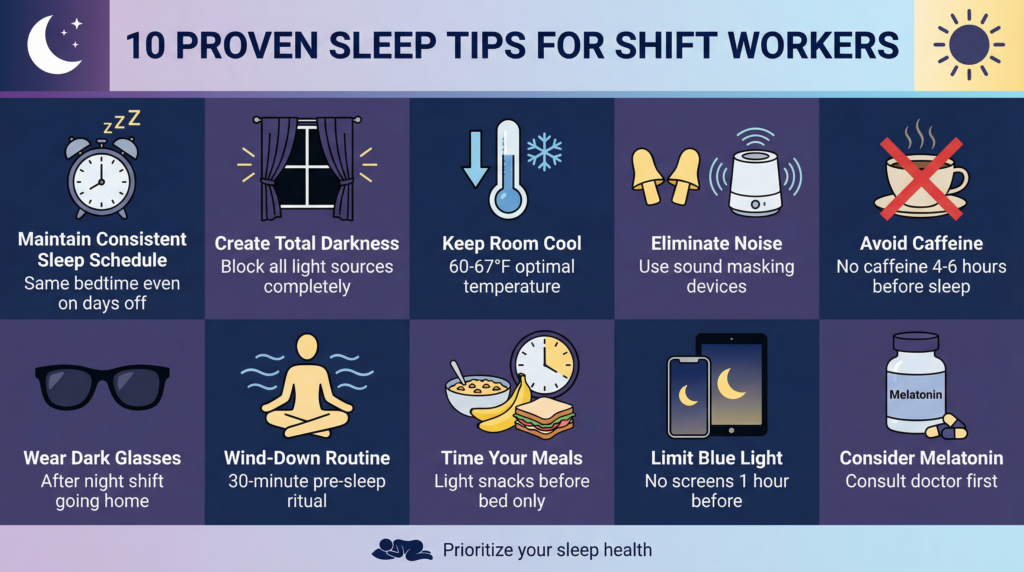
🌙 10 Proven Sleep Tips for Shift Workers
These approaches are created to work with your biology, not against it.
1. Protect One “Anchor Sleep Window.”
Even if your schedule rotates, choose one steady sleep block (4–5 hours) that stays the same every workday.
This anchor helps stabilize your brain’s melatonin release.
Consistency beats duration.
2. Control Light Exposure Aggressively
Light is the strongest circadian signal.
- Wear blue-light–blocking glasses on the way home from night shifts.
- Use blackout curtains or an eye mask.
- Keep your sleep space completely dark.
This prevents early daylight from telling your brain, “It’s daytime — stay awake.”
3. Create a “Fake Night” Routine
Your brain needs predictable cues, even if they’re artificial.
Before sleep:
- Dim lights
- Shower
- Stretch
- Drink herbal tea
- Follow the same sequence every time.
This trains your nervous system to rest at any time.
4. Eat Strategically (Not Constantly)
Shift workers often snack continuously, which confuses the body clock.
Best approach:
- Eat your largest meal early in your “day.”
- Avoid heavy meals 2–3 hours before sleep.
- Keep sleep-time digestion minimal.
Food timing is a powerful circadian signal.
5. Limit Caffeine Earlier Than You Think
Caffeine has a 6–8 hour half-life — sometimes longer in stressed individuals.
For night shifts:
- Use caffeine early
- Avoid it in the final half of your shift.
- Never use caffeine to “push through” exhaustion.
Caffeine blocks deep sleep, even if you nap.
6. Support Your Nervous System (Shift Work = Stress)
Shift work keeps your body in alert mode.
Natural supports that help calm the system:
- Magnesium glycinate
- L-theanine
- GABA-supporting herbs
- Lemon balm and valerian
Balanced formulas like Yusleep aid calmness without sedation or dependency.
7. Nap With Intention (Not Randomly)
Naps can help — or hurt.
Best practice:
- Keep naps 20–40 minutes.
- Nap before a night shift, not after
- Avoid long daytime naps that steal sleep pressure.
8. Protect REM Sleep Whenever Possible
REM sleep is already fragile for shift workers.
To protect it:
- Avoid alcohol
- Keep sleep uninterrupted
- Use white noise
- Place importance on the second half of your sleep block.
REM restores emotional balance, critical for resilience.
9. Move Your Body (But Not Before Sleep)
Exercise helps anchor circadian rhythm — but timing matters.
- Light movement during your “day.”
- Avoid intense workouts before sleep.
- Gentle stretching is ideal pre-sleep
10. Accept That “Perfect Sleep” Isn’t the Goal
The biggest mistake shift workers make is chasing ideal sleep.
The real goal is:
- Better sleep quality
- Less fragmentation
- Lower stress
- More consistency
Progress, not perfection, restores energy.
This nightshift sleep calculator helps estimate an ideal sleep window based on your shift type, so your sleep timing supports recovery instead of fighting your biology.
What this sleep calculator helps with:
- Choosing the best time to sleep after a night shift
- Reducing early wake-ups caused by cortisol spikes
- Improving sleep quality (not just sleep length)
- Creating more consistent recovery on workdays and off days
👉 Improve Your Sleep using the Night Shift Sleep Schedule Calculator
Why Shift Workers Need a Different Sleep Strategy
Most sleep advice assumes:
- A normal schedule
- Daylight exposure
- Evening wind-down
Shift workers don’t fit that pattern.
That’s why understanding:
- Circadian rhythm reset
- Deep sleep protection
- REM sleep optimization
That’s why generic sleep advice misses the needs of shift workers.
🌙 How This Fits Into Your Sleep Journey
If you’re a shift worker, we recommend this path:
1️⃣ Root Causes of Chronic Insomnia
→ Understand why your sleep feels broken
2️⃣ How to Reset Your Circadian Rhythm Naturally
→ Learn how to realign your internal clock
3️⃣ The Science of Deep Sleep
→ Protect physical recovery
4️⃣ 5 Ways to Get More REM Sleep
→ Restore mental clarity
5️⃣ Evening Routines That Train Your Brain for Sleep
→ Create consistency anywhere
FAQs
Is shift work bad for sleep in the long term?
Yes — without intervention. By applying the right strategies, damage can be significantly reduced.
Can melatonin help shift workers?
Short-term use may help with timing, but habits and light control matter more.
Why do I feel anxious after night shifts?
Circadian disruption increases cortisol and reduces REM sleep.
Is it possible to feel rested as a shift worker?
Yes — but only with intentional sleep protection strategies.
🌟 Conclusion: You’re Not Broken — You’re Misaligned
Shift work doesn’t mean you’re destined for exhaustion.
When you understand how it disrupts sleep — and how to counteract it — your body can adapt.
With the right routines, environment, and support, better sleep is still possible.