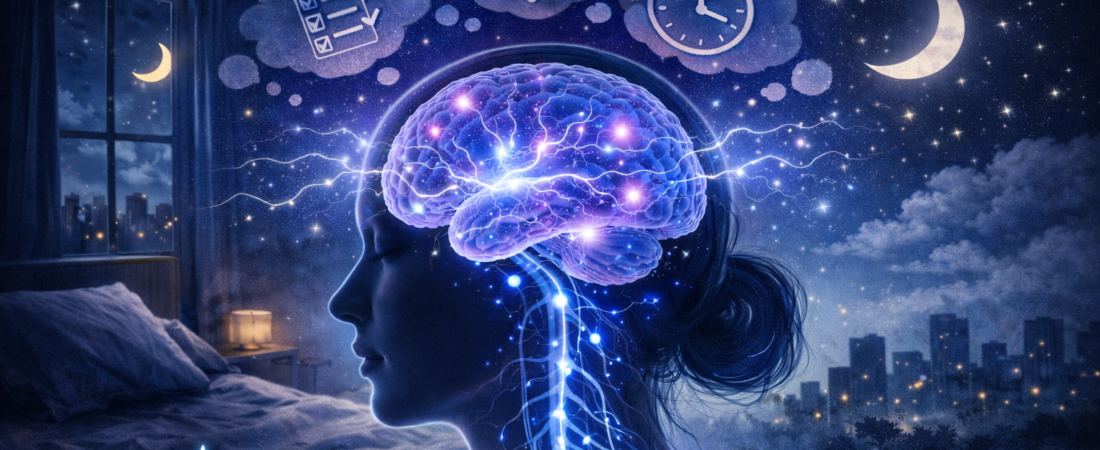
You’re exhausted all day, yet the moment you lie down, your mind switches on. Thoughts race. Worries resurface. Sleep feels close, but disrupted and you unrested in the morning.
If this happens nightly, you’re experiencing anxiety-driven insomnia—a sleep disruption rooted in a brain and nervous system that won’t power down at night, rather than poor habits.
This article explains why your brain won’t shut off, how anxiety keeps sleep out of reach, and what actually helps restore rest when overthinking takes over.
🧠 Before You Watch:
Anxiety-driven insomnia isn’t just “in your head.” This short explainer shows what’s happening inside your brain when you can’t turn off your thoughts — and how to reset your nervous system naturally.
🌙 What You Just Learned:
Your brain isn’t broken — it’s overprotective. With the right cues, you can retrain it to feel safe enough to rest again.
👉 Explore our full guide below to discover calming habits, natural supports, and simple ways to quiet your mind before bed.
What Anxiety-Driven Insomnia Feels Like
Anxiety-driven insomnia has a distinct pattern. People often describe:
- Feeling tired yet not sleepy
- A flood of mental activity at bedtime
- Difficulty “letting go” mentally
- Light, restless sleep
- Repeated awakenings
- Early-morning anxiety
Unlike insomnia caused by schedule issues or illness, this type is driven by hyperarousal—a state where the brain remains alert even when the body needs rest.
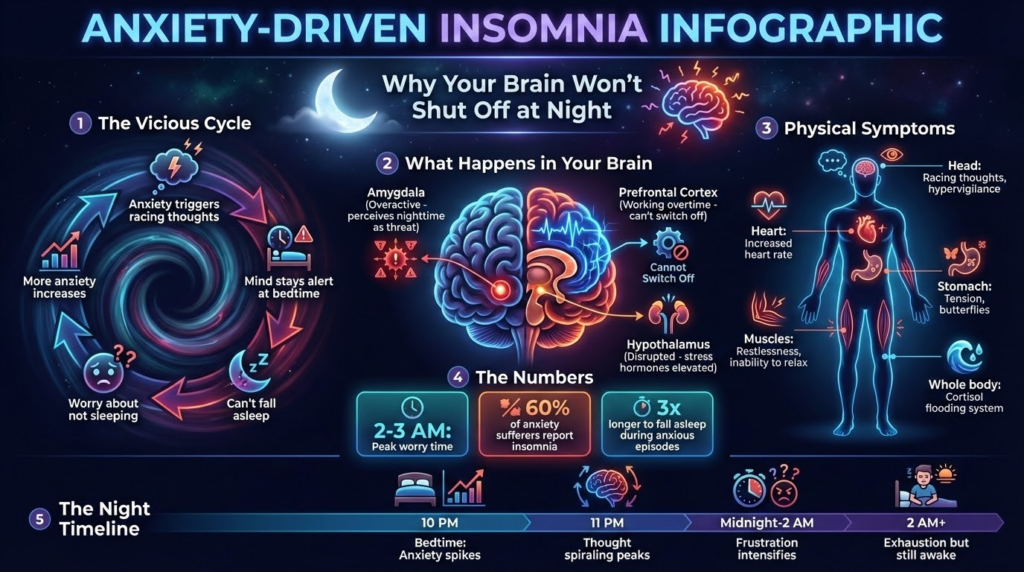
Why Your Brain Won’t Shut Off at Night
Why does anxiety cause insomnia?
Anxiety causes insomnia by keeping the brain in a state of alertness. When stress hormones remain elevated at night, the nervous system stays active, preventing the brain from entering deep, restful sleep.
The brain’s primary job is to protect you. When anxiety is present—whether obvious or subtle—it continues scanning for threats.
At night, distractions disappear. The brain finally has space to process unresolved stress, which can show up as:
- Racing thoughts
- Mental replaying
- Anticipatory worry
- Problem-solving mode
Instead of winding down, the brain interprets bedtime as a moment to remain alert.
The Nervous System Is the Real Issue
At the core of anxiety-driven insomnia is nervous system hyperarousal.
This means:
- The sympathetic (“fight-or-flight”) system stays active.
- Cortisol remains elevated at night.
- The parasympathetic (“rest-and-digest”) system never fully takes over.
Even though you’re tired, your body doesn’t feel safe enough to sleep deeply.
This is why people often say: “My body is tired, but my mind won’t stop.”
Why Traditional Sleep Advice Often Fails
Most sleep advice focuses on behavior:
- Better sleep hygiene
- Earlier bedtimes
- Cutting down screen use
While helpful for mild sleep problems, these strategies don’t address hyperarousal.
For anxiety-driven insomnia, the issue isn’t what you’re doing at bedtime—it’s what your nervous system is doing.
That’s why people can follow every rule and still lie awake.
Why Sleep Aids Don’t Fix Anxiety-Driven Insomnia
Featured Snippet: Do sleep aids help with anxiety and insomnia?
Sleep aids may increase drowsiness, but they do not reduce anxiety-driven nervous system activation. As a result, sleep often remains light, fragmented, or unrefreshing.
Sleep aids work by increasing sedation. Anxiety-driven insomnia persists because sedation doesn’t tell the nervous system it’s safe.
Common experiences include:
- Feeling drugged but mentally alert
- Falling asleep briefly, then waking up
- Next-day grogginess without feeling restored
Over time, this can increase stress and worry about sleep itself.
Sleep Fragmentation: The Hidden Impact of Anxiety
Anxiety-driven insomnia rarely means no sleep at all. Instead, it causes broken, unrestful sleep.
This includes:
- Frequent micro-awakenings
- Reduced deep sleep
- Shortened REM cycles
That’s why many people:
- Sleep 7–8 hours
- Wake feeling exhausted
- Feel mentally drained during the day.
Sleep quantity looks fine on paper—sleep quality does not.
Why “Trying Harder” Makes Sleep Worse
One of the most painful aspects of anxiety-driven insomnia is effort.
People try to:
- Force relaxation
- Control thoughts
- Monitor sleep closely
Unfortunately, effort signals danger to the nervous system.
Sleep is a passive process. The harder you try, the more alert the brain becomes.
What Actually Helps Anxiety-Driven Insomnia
Improvement begins when the goal changes.
Not:
❌ “How do I knock myself out?”
But:
✅ “How do I reduce nighttime alertness?”
What helps most:
- Calming the nervous system before bed
- Decreasing mental and physiological arousal
- Improving sleep continuity
- Removing pressure from sleep itself
This is why approaches focused on calmness, diet, and reducing stress steadily outperform sedation for anxiety-based sleep problems.
Anxiety-driven insomnia persists when the nervous system stays in alert mode at night, regardless of how tired you feel.
👉 Understanding why the nervous system remains active at night is often the key to fixing anxiety-driven insomnia.
Read more at: Root Causes of Chronic Insomnia & What Actually Helps
The Gut–Brain Connection and Nighttime Anxiety
Anxiety-driven insomnia is frequently intensified by physiological factors, including gut health.
The gut influences:
- Inflammation
- Neurotransmitter balance
- Stress hormone control
When gut health is compromised, nighttime anxiety and sleep disruption often increase—further strengthening the hyperarousal cycle.
Why This Type of Insomnia Is So Common
Is anxiety insomnia common?
Yes. Anxiety-driven insomnia is one of the most common forms of chronic insomnia, especially among adults dealing with long-term stress, responsibility, or sleep frustration.
Modern life encourages constant mental engagement. Over time, the brain forgets how to fully disengage at night.
This isn’t a personal failure—it’s a learned response.
For many people, anxiety-driven insomnia continues because every solution focuses on forcing sleep instead of restoring calm.
👉 When sleep won’t come because your mind won’t shut off, approaches that reduce nighttime hyperarousal tend to work better than sedation.
❓ FAQ: Anxiety-Driven Insomnia
Can anxiety cause insomnia even when I’m tired?
Yes. Anxiety keeps the nervous system alert, preventing deep sleep even when the body is exhausted.
Why do my thoughts race more at night?
At night, distractions fade, processed unresolved stress surfaces, leading to heightened mental activity.
Does anxiety insomnia go away on its own?
It can, but chronic cases often persist until the nervous system learns to feel safe at night again.
Is anxiety-driven insomnia different from stress insomnia?
They overlap, but anxiety-driven insomnia involves sustained hyperarousal rather than short-term stress.
Final Thoughts: Your Brain Isn’t Broken
If your brain won’t shut off at night, it doesn’t mean you’re doing something wrong.
It means your nervous system hasn’t learned that night is safe again.
Once that signal changes, sleep often returns naturally.
Anxiety-driven insomnia isn’t about willpower—it’s about recognizing and managing what keeps your brain working at night when you should be winding down for sleep
👉 If your mind won’t shut off at night, learning what’s actually driving that alertness is the first real step toward better sleep.