
Introduction
Ashwagandha has become a top herb in sleep and stress research — and for good reason.
Unlike supplements that aim to “knock you out,” ashwagandha works upstream, targeting the stress response that keeps many people awake at night. This makes it especially appealing to health-conscious adults, caregivers, shift workers, and anyone hesitant to rely on prescription sleep medications.
But ashwagandha isn’t a sedative — and that’s where much of the confusion begins.
Some people report better sleep within weeks. Others feel nothing. And many are unsure whether it’s even meant to help with sleep at all.
In this article, we’ll take a clear, science-based look at ashwagandha for sleep, how it works, who benefits most, common mistakes, and where it fits when people search for the best natural sleep aid.
🎥 Watch this before trying another sleep supplement.
Ashwagandha doesn’t work like a sleeping pill — and that’s why many people misunderstand it. This video explains who it helps, who it doesn’t, and how to use it correctly.
Ashwagandha works best when stress is the primary issue —not sleep pressure. Below, you’ll find a deeper breakdown of how it fits into a complete, science-based sleep strategy.
Fundamental Guidelines: How Ashwagandha Supports Sleep
Ashwagandha doesn’t directly induce sleep. Instead, it helps remove the barriers that prevent sleep from happening naturally.
1. Ashwagandha Calms the Stress Response
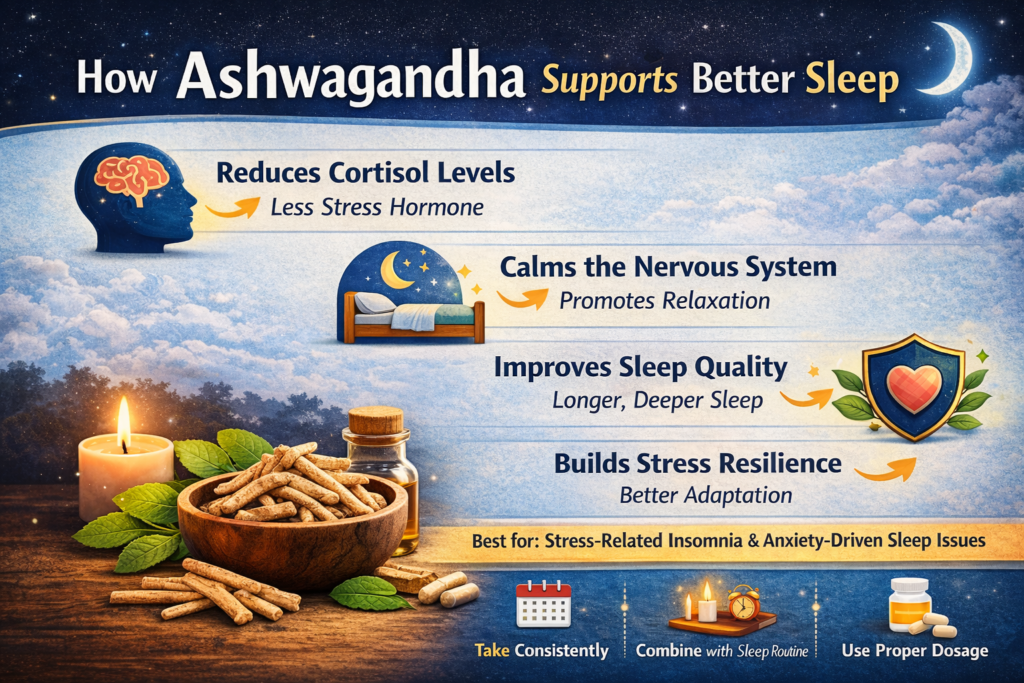
Ashwagandha promotes sleep by lowering cortisol, the main stress hormone.
Chronically elevated cortisol — especially at night — is one of the most common reasons people feel:
- Tired but wired
- Unable to shut their mind off
- Restless despite exhaustion
Ashwagandha is classified as an adaptogen, meaning it helps the body adapt to stress rather than suppressing it.
Research shows it can:
- Reduce cortisol levels over time.
- Improve stress resilience
- Support calmer nervous system signaling.
This is particularly helpful for:
- Working professionals under chronic pressure
- New parents with constant alertness
- People whose insomnia worsens during stressful life periods
👉 Learn how stress hormones interfere with sleep — and how to calm them naturally
2. It Supports Nervous System Balance, Not Sedation
Unlike sleep medications or high-dose melatonin, ashwagandha does not sedate the brain.
Instead, it supports:
- Parasympathetic (rest-and-digest) activation
- Reduced nighttime alertness
- Improved emotional management
This is why many people describe sleep on ashwagandha as:
- More natural
- Less groggy
- Easier to wake from
For people sensitive to medications or grogginess, this can be a major advantage.
3. Ashwagandha May Improve Sleep Quality Over Time
While it may not help everyone fall asleep faster on night one, studies suggest consistent use can:
- Improve sleep efficiency
- Reduce nighttime awakenings
- Increase perceived sleep quality.
This suits chronic, stress-related sleep issues more than occasional sleeplessness.
Advanced Strategies: Using Ashwagandha Correctly for Sleep
Where most people go wrong with ashwagandha is in their expectations and timing.
Ashwagandha Works Best as a Foundation
Ashwagandha works best when combined with:
- Consistent evening routines
- Proper light exposure
- Stable meal timing
- Nervous system regulation during the day
Alone, it may help — but with context, it helps more.
👉 See why multi-ingredient and system-based sleep strategies outperform single supplements
Timing Matters
Most people do best when taking ashwagandha:
- In the evening
- Or split between morning and evening.
Because it helps regulate stress, some people also benefit from daytime use to prevent cortisol from remaining elevated into the night.
Who Benefits Most from Ashwagandha
Ashwagandha is especially helpful for people with:
- Stress-driven insomnia
- Anxiety-related night wakings
- Burnout-related sleep disruption
- Light, non-restorative sleep
It is less effective for:
- Circadian rhythm disorders alone
- Shift workers without stress involvement.
- Pain-driven insomnia
👉 See how different types of insomnia require different approaches
Common Pitfalls and Misconceptions
1. Expecting Immediate Sedation
Ashwagandha is not a sleeping pill. Expecting instant results leads to disappointment.
2. Using It Inconsistently
Adaptogens work best with regular use.
3. Ignoring Root Causes
Ashwagandha won’t override:
- Severe circadian misalignment
- Chronic inflammation
- Poor sleep timing
4. Overdosing
More is not better. Excessive doses may cause digestive discomfort or daytime fatigue.
Expert Advice: Where Ashwagandha Fits in a Sleep Strategy
Ashwagandha should be viewed as:
- A stress buffer, not a sleep inducer
- A support tool, not a cure
- One layer of a larger system
For many people searching for the best natural sleep aid, the real solution isn’t stronger ingredients — it’s addressing why the body won’t downshift at night.
👉 Understand the real root causes of chronic insomnia — not just symptoms
Conclusion
Ashwagandha isn’t a miracle sleep solution — and that’s actually its strength.
By calming stress hormones, supporting nervous system balance, and improving resilience over time, it helps create the conditions where sleep can return naturally.
For people whose insomnia is affected by stress, anxiety, and fatigue, ashwagandha can be a valuable part of a wider sleep strategy. But lasting improvement comes from combining it with circadian alignment, regular routines, and realistic expectations.
If sleep has become a nightly struggle, the goal isn’t to force rest — it’s to help the body feel safe enough to let go.