
Why Night Shift Recovery on Night Shift After Work Feels Impossible
If you work nights and still feel exhausted even after sleeping, you’re not failing at sleep — your body is. Understanding the importance of Recovery on Night Shift is crucial.
Many night shift workers suffer horribly.
- Sleep during the day.
- Use blackout curtains
- Try to get enough hours.
Yet still feel:
- Constant fatigue
- Brain fog
- Poor physical recovery
- No energy
This problem often co-occurs with caffeine dependence, short sleep duration, and irregular schedules, all covered in our guide on the Best Sleep Schedule for Night Shift Workers (Permanent vs Rotating Shifts).
But there is one sleep habit that does more damage than all the others combined.
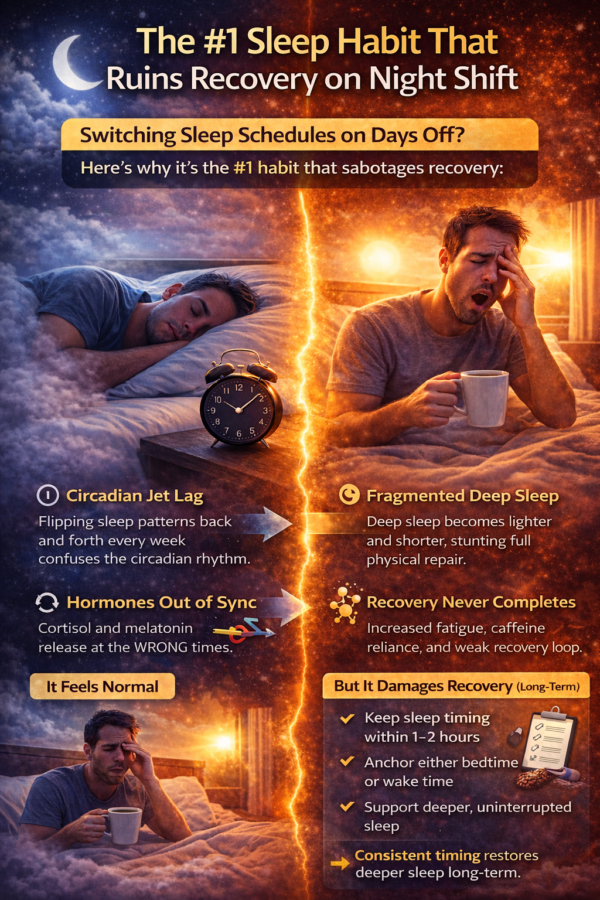
The #1 Sleep Habit That Ruins Recovery on Night Shift
Inconsistent Sleep Timing — Especially on Days Off
This is the biggest recovery killer for night shift workers.
Not caffeine.
Not light exposure.
Not even short sleep.
👉 Switching your sleep schedule on days off is the #1 habit that ruins recovery on night shift.
Why Almost Every Night Shift Worker Does This
Most night shift workers:
- Sleep during the day on workdays.
- Switch to sleeping at night on days off.
- Flip back again before the next shift.
- Switch from dayshift to night shift and vice versa
It feels anti-social.
It feels necessary.
It feels harmless.
👉You feel like a zombie eventually…
But biologically, it keeps your body in constant circadian jet lag.
This same pattern shows up repeatedly in 5 Sleep Mistakes Almost Every Night Shift Worker Makes, where inconsistent sleep timing quietly undermines recovery even when total sleep hours look acceptable.
What Ruins Sleep Recovery on Night Shift?
The #1 sleep habit that ruins recovery on night shift is inconsistent sleep timing, especially switching sleep schedules on days off. This disrupts circadian rhythm, reduces deep sleep, and prevents full physical and mental recovery.
Why Switching Sleep Schedules Wrecks Recovery
Your body relies on predictable timing to regulate:
- Melatonin
- Cortisol
- Growth hormone
- Muscle repair
When sleep timing constantly changes:
- Deep sleep becomes fragmented.
- Recovery hormones are released at the wrong time.
- Sleep becomes lighter and less restorative.
You may still sleep, but your body never fully repairs itself.
Why You Can Sleep “Enough” and Still Feel Awful
This is where many night shift workers get confused.
You might:
- Sleep 7–8 hours
- Fall asleep quickly
- Avoid distractions
Yet still wake up:
- Drained
- Sore
- Mentally foggy
😴 Sleeping but not recovering on night shift? This happens when your sleep timing changes too often. Supporting deeper, uninterrupted sleep with consistent timing helps your body recover. 👉 Learn how to support better sleep recovery naturally.
The Hidden Cost of “Catching Up” on Days Off
Sleeping at night on days off feels good short term.
But the cost appears later:
- Worse sleep before work shifts
- Shorter sleep duration
- Increased caffeine reliance
Many workers stuck in this loop also struggle to sleep longer than 5–6 hours, as explained in Why Night Shift Workers Can’t Sleep More Than 6 Hours.
Why This Habit Is Worse Than Short Sleep
Short sleep can be recovered from.
Circadian disruption compounds.
That’s why inconsistent sleep timing causes:
- Chronic fatigue
- Poor immune recovery
- Long-term burnout
Over time, your body stops adapting altogether.
Why Night Shift Workers Feel “Always Tired”
This habit creates a feedback loop:
- Inconsistent sleep timing
- Poor recovery
- More caffeine
- Lighter sleep
- Even worse recovery
Caffeine often makes this worse by reducing sleep depth even when you feel exhausted, which is why it plays such a major role in Does Caffeine Affect Sleep Even If You Feel Tired?
What to Do Instead (Recovery-Friendly Sleep Timing)
You don’t need perfection.
You need predictability with your sleep.
Better Options for Days Off
- Keep sleep timing within 1–2 hours.
- Anchor either bedtime or wake time
- Protect your main sleep block.
Even partial consistency improves recovery, energy, and how you feel on a daily basis.
If You Can’t Keep the Same Schedule
Not everyone can fully stay on a night schedule — and that’s okay.
Focus on:
- Stable sleep windows
- Light control
- Caffeine timing
- Moderate or eliminate alcohol
- Nervous system recovery
🌙 If night shift fatigue feels constant, your sleep system may need support. YuSleep is designed to help calm the nervous system and support deeper, more restorative sleep — especially for people with irregular schedules. 👉 See how YuSleep supports better sleep recovery.
How Long Until Recovery Improves?
Most night shift workers notice:
- Better sleep depth in 5–7 days
- Improved energy within 1–2 weeks
- Less caffeine dependence in 2–3 weeks
- Improved focus
- Overall well being
Consistency works faster than most people expect.
Frequently Asked Questions (FAQs)
Why do night shift workers feel exhausted even after sleeping?
Inconsistent sleep timing disrupts deep sleep and the release of recovery hormones.
Is switching sleep schedules on days off really that bad?
Yes. It’s the most common reason recovery fails on night shift.
Is it better to stay on a night schedule full-time?
For recovery, yes — even partial consistency helps.
Can naps replace consistent sleep timing?
No. Naps help fatigue, but don’t fix circadian disruption.
Does caffeine make recovery worse?
Yes. It masks fatigue while reducing sleep depth.
Conclusion: Recovery Requires Consistency, Not More Sleep
If you want to feel better on the night shift, this is the habit to fix first.
👉 The #1 sleep habit that ruins recovery on night shift is inconsistent sleep timing — especially on days off.
Sleeping more won’t fix it. Supplements alone won’t fix it. There is something that does help sleep and is all natural.
💤 Recovery comes from predictable sleep — and supporting your body’s ability to stay in deep sleep.
👉Try YuSleep and support deeper recovery on night shift.