Waking up at the same time every night, often between 2:00 and 4:00 a.m., can feel unsettling. You are tired and want to sleep, yet your body wakes you up like clockwork. For many, this pattern repeats night after night, no matter how exhausted they feel or how early they went to bed.
This isn’t random. And it isn’t a sign that you’re “bad at sleeping.”
In most cases, consistent night wakings are caused by predictable biological and neurological brain signals — not willpower, discipline, or lack of effort.
In this guide, we’ll break down:
Understanding Why You Wake Up at the Same Time Every Night can help you identify the underlying issues affecting your sleep.
- The most common reasons people wake up at the same time every night
- What your body is doing during those hours
- Why stress, hormones, blood sugar, and sleep cycles matter more than sleep duration
- What actually helps stop recurring night wakings
🎥 Ever feel exhausted at night but unable to shut your mind off? This short video explains how stress hormones—especially cortisol—can keep your brain alert even when your body is desperate for sleep.
If cortisol is staying elevated at night, deeper sleep won’t happen on its own. Calming the nervous system—rather than forcing sleep—is often what finally helps restore more stable, restorative rest.
👉 See how Yusleep supports deeper sleep by addressing stress-related sleep disruption
Quick Answer
Why do I wake up at the same time every night?
Most people wake up at the same time every night due to stress hormones (especially cortisol), dips in blood sugar, disrupted sleep cycles, or misalignment of the biological clock. These signals can trigger alertness even when you’re exhausted.
Why Repeated Night Wakings Feel So Specific
One of the most frustrating things about night wakings is how precise they feel.
- Always around 2:30 a.m.
- Always just before 4:00 a.m.
- Always after exactly 4–5 hours of sleep
This pattern leads many people to assume something is “wrong.” In reality, your body follows very consistent internal rhythms — especially during the second half of the night.
To understand why this happens, we need to look at what’s going on inside your body while you sleep.
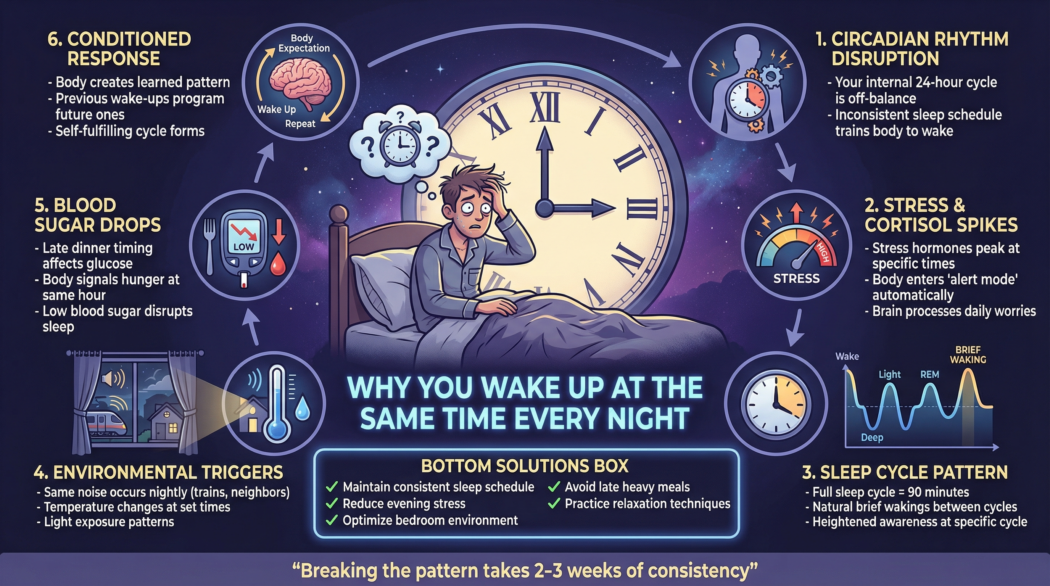
What Happens in Your Body Between 2–4 am
Sleep is not a flat state. It moves through cycles of:
- Light sleep
- Deep sleep
- REM sleep
In the second half of the night, two important things happen:
- Deep sleep decreases
- Stress hormones naturally begin to rise.
This combination makes sleep more fragile.
If anything pushes your body toward alertness, such as stress, blood sugar changes, or nervous system activation, you are more likely to wake up.
This is why night wakings tend to happen at the same time, not randomly.
The #1 Cause: Cortisol Rising Too Early
Cortisol is your body’s main alertness hormone. It’s supposed to rise in the early morning to help you wake up.
But for many people, cortisol rises too early.
Why does cortisol wake you up at night?
- Chronic stress keeps cortisol elevated all day.
- Poor sleep quality increases nighttime cortisol.
- Anxiety conditions the nervous system to stay alert
- Irregular schedules confuse circadian timing.
When cortisol rises too early, your brain interprets it as a signal to wake up, even if you are exhausted.
Can cortisol cause night wakings?
Yes. Elevated cortisol levels at night can trigger early awakenings by increasing alertness and preventing the brain from remaining in deep or REM sleep.
This is one of the most common reasons people feel tired but wired.
If stress hormones are rising too early, sleep can feel light and fragmented. This guide explains why sleep quality matters more than sleep duration — and what actually improves it.
👉 How to Get Quality Sleep (What Actually Works vs. What Backfires)
Blood Sugar Drops: An Overlooked Trigger
Another common cause of waking at the same time every night is blood sugar instability.
What happens
- Blood sugar drops during the night
- The body releases cortisol and adrenaline to compensate.
- These hormones wake you up.
This often happens:
- After high-carbohydrate dinners
- When meals are too light or too early
- During calorie restriction
- In people sensitive to blood sugar swings
Signs that blood sugar may be involved
- Waking with a racing heart
- Feeling anxious or shaky
- Difficulty falling back asleep
- Night sweats
Your body is not trying to sabotage your sleep. It is trying to protect your brain from low glucose.
Many people who wake up at the same time every night also notice they feel exhausted even after a full night in bed. This article explains why sleep can feel unrefreshing — and what helps restore deeper recovery.
👉 Why You Wake Up Tired Even After 8 Hours of Sleep
Light Sleep Cycles Make You Vulnerable
Sleep cycles last about 90 minutes. If you wake at the same time every night, you may be consistently hitting a light sleep stage at that point.
Light sleep makes you:
- More sensitive to stress
- More reactive to noise or temperature
- More aware of internal sensations
This explains why:
- You may wake up for “no reason.”
- Falling back asleep feels harder than it should
- Your mind suddenly feels alert.
The problem is not that you woke up. It is that your nervous system did not power back down.
Anxiety and a Hyper-Alert Nervous System
Many people who wake at the same time every night also experience:
- Racing thoughts
- A feeling of anxiety or alertness
- Body tension
- Shallow breathing
This is not a psychological weakness. It is nervous system conditioning.
When your brain learns that nighttime is a place of stress, it stays partially alert while asleep.
Over time, your body begins to expect wakefulness at certain hours.
Circadian Rhythm Misalignment
Your circadian rhythm is your internal clock. It controls:
- Sleep timing
- Hormone release
- Body temperature
- Energy levels
When it’s misaligned, night wakings become more likely.
Common causes
- Inconsistent bedtimes
- Late-night screen exposure
- Shift work or irregular schedules.
- Eating late at night
- Traveling across time zones
- Doom scrolling
Even small sleep interferences can shift when your body thinks it is time to wake.
Why Sleep Aids Often Don’t Fix Night Wakings
Many people try sleep aids when night wakings start — but find they:
- Fall asleep faster
- Still wake up at the same time.
- Feel groggy but alert.
Most sleep aids sedate but do not calm stress signals or stabilize sleep architecture.
If the underlying trigger is cortisol, blood sugar, or nervous system activation, sedation alone will not solve it.
This is why people often say:
“I’m sleeping, but I’m not resting.”
What Actually Helps Stop Waking at the Same Time Every Night
There is no single fix, but there is a pattern.
1. Focus on sleep quality, not just duration
Deep and REM sleep matter more than the number of hours.
2. Reduce evening stress signals
Your body needs clear signals that it’s safe to stay asleep.
3. Stabilize blood sugar overnight
Balanced meals and timing matter more than most people realize.
4. Support circadian timing
Light exposure, routines, and consistency matter.
5. Calm the nervous system, not just knock yourself out
This is where many people finally see progress.
When Night Wakings Are a Signal (Not a Failure)
Waking at the same time every night is not your body failing at sleep.
It’s your body communicating:
- The stress signals are too high.
- That recovery isn’t complete.
- That sleep is too light.
- That timing is off
Once you address the signal, not just the symptom, sleep often becomes deeper and more stable.
When sleep problems persist, it’s often because the nervous system never fully powers down. Understanding why sleep aids stop working is often the turning point.
Read more at: Why Sleep Aids Stop Working (And What Actually Helps)
FAQ
Why do I wake up at 3am every night?
Waking at 3am is commonly linked to cortisol release, light sleep phases, or blood sugar drops that trigger alertness.
Is waking up at night normal?
Occasional night wakings are normal. Repeated, timed wakings often indicate stress or circadian disruption.
Why can’t I fall back asleep after waking?
Once alertness hormones rise, the brain may struggle to re-enter deep sleep without calming signals.
When night wakings are driven by stress signals and light sleep, calming the nervous system matters more than stronger sleep aids. Some people find that multi-ingredient formulas designed for sleep quality — not just sedation — help support deeper, more stable sleep.
Final Thoughts
If you wake up at the same time every night, you are not broken and you are not alone.
This pattern is one of the most common signs of non-restorative sleep. It usually improves when you stop fighting sleep and start supporting the systems that control it.
Understanding why it happens is the first step toward finally sleeping through the night.