
Overview
CBD and CBN are everywhere in the sleep supplement market.
From oils and gummies to capsules and beverages, these cannabinoids are frequently marketed as gentle, natural solutions for insomnia — especially for people who want to avoid prescription sleep medications.
But despite the hype, many people are left confused:
- Why does CBD help some people relax but not sleep?
- Is CBN really “the sleep cannabinoid”?
- Why do results vary so widely?
- And are either of them truly the best natural sleep aid, or just well-marketed trends?
In this article, we’ll take a critical, science-based look at CBD and CBN for sleep. We’ll compare how they work, who they help most, where they fall short, and how they fit into a realistic sleep strategy.
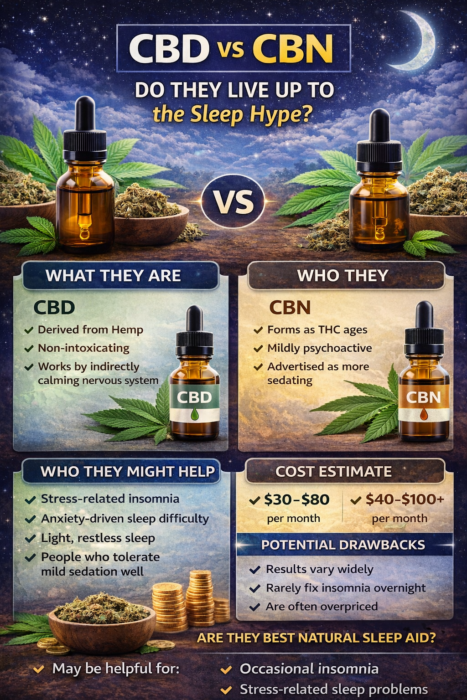
Feature Comparison: CBD vs CBN
What Is CBD?
CBD (cannabidiol) is a non-intoxicating compound extracted from hemp. It does not cause a “high” and is widely used for:
- Stress reduction
- Anxiety support
- Inflammation management
- Nervous system regulation
When it comes to sleep, CBD’s effects are indirect. It doesn’t induce sleep — instead, it may reduce the factors that interfere with it.
What Is CBN?
CBN (cannabinol) is a mildly psychoactive cannabinoid formed as THC ages. It is often marketed specifically for sleep due to its reputation for inducing sleep. CBN’s mild psychoactive effects mean it may produce slight alterations in mood or perception, but it does not typically lead to significant impairment. Safety considerations include the potential for drowsiness; caution is advised when engaging in activities requiring full alertness, such as driving.
Pregnant or nursing individuals, as well as those with pre-existing health conditions, should consult a healthcare provider before using CBN.
However, CBN research is far more limited than CBD research, and many claims are based on:
- Animal studies
- Anecdotal reports
- Combination products (CBN + CBD + melatonin)
This makes it harder to separate marketing from mechanism.
If CBD or CBN hasn’t delivered consistent sleep, the issue is often timing and stress—not the compound itself.
Many people get better results when they stop chasing single ingredients and instead support the nervous system as a whole.
→ See how a system-based, non-sedating sleep approach like Yusleep compares
Performance Analysis: How They Alter Sleep
CBD and Sleep Quality
CBD appears most helpful for people whose sleep issues are driven by:
- Stress
- Anxiety
- Nervous system hyperarousal
- Chronic mental overactivity
Possible advantages include:
- Easier relaxation before bed
- Reduced nighttime anxiety
- Improved sleep continuity
However, CBD does not consistently help people fall asleep faster, especially when sleep problems are caused by circadian rhythm disruption.
👉 Learn why calming the nervous system helps some people sleep — and why it’s not enough for everyone
CBN and Sleep Onset
CBN is often promoted as more sedating than CBD, but the evidence is still emerging.
Some users report:
- Faster sleep onset
- Heavier, more drowsy feelings
- Increased sleepiness
Others report:
- Grogginess
- Vivid dreams
- Inconsistent effects
Most positive outcomes occur in multi-ingredient formulas, making it difficult to attribute results solely to CBN.
👉 See why multi-ingredient sleep strategies frequently outperform single compounds
Price Comparison: Cost vs Value
CBD and CBN products vary dramatically in price.
To make informed, safe choices, consider looking for reputable brands that offer comprehensive product details.
Key factors include third-party testing and clear labeling of cannabinoid content. This ensures dosage accuracy and safety standards are met.
- CBD products: $30–$80 per month
- CBN-focused products: $40–$100+ per month
Higher prices don’t always equal better results. Factors that matter more than cost include:
- Third-party testing
- Cannabinoid dosage transparency
- Product formulation
- Consistency of use
For many users, the expense becomes frustrating when results are subtle or inconsistent.
Best For Different Types of Sleep Problems
CBD May Be Best For:
- Stress-related insomnia
- Anxiety-driven sleep difficulty
- Light, restless sleep
- People sensitive to sedatives
CBN May Be Better For:
- Difficulty falling asleep
- People who tolerate mild sedation well
- Occasional sleeplessness rather than chronic insomnia
Less Effective For Both:
- Shift workers with circadian misalignment.
- Jet lag without routine adjustment
- Hormonal or inflammation-driven insomnia
👉 Understand how circadian rhythm disruption affects sleep — and why supplements alone often fail
Common Pitfalls With CBD and CBN
1. Expecting Immediate Results
Neither CBD nor CBN reliably fixes insomnia overnight.
2. Using Them Without Context
They work best alongside:
- steady sleep habits
- Light management
- Stress reduction
3. Confusing Relaxation With Sleep Repair
Feeling calmer doesn’t always mean deeper, deeper, restorative sleep.
Final Recommendation: Are CBD or CBN Worth Trying?
CBD and CBN are not miracle sleep solutions, but they can be helpful under certain conditions. CBD can support those whose sleep is disrupted by stress or anxiety, while CBN may aid some individuals in falling asleep faster.
However, the evidence for CBN remains limited, and results can vary widely. It’s important to note that these compounds may also come with side effects or interact with other medications. Users should be aware of potential drowsiness, changes in mood, or interactions with drugs like sedatives or blood thinners. Consulting with a healthcare provider is advised to ensure safety and effectiveness.
Neither compound reliably addresses:
- Chronic insomnia
- Circadian rhythm disorders
- Conditioned sleep anxiety
For people searching for the best natural sleep aid, the most consistent improvements come from system-based approaches — not isolated compounds.
👉 Learn what actually improves sleep long-term — not just temporarily
Conclusion
CBD and CBN live somewhere between promise and over-marketing.
They may support sleep for certain people, especially when stress is the primary barrier. But they work best as support tools, not independent solutions.
If sleep has become unpredictable or frustrating, the goal isn’t to sedate the brain — it’s to help the body feel safe enough to rest naturally.