Introduction: Why Exhaustion Doesn’t Guarantee Sleep on Night Shifts
If you work nights, you’ve probably experienced this frustrating pattern:
- You’re exhausted by the end of your shift.
- Your body feels heavy and drained.
- But when you finally lie down… your mind won’t shut off.
This “tired but wired” feeling isn’t a failure of relaxation or willpower. It’s often a hormonal timing issue, largely driven by cortisol.
Understanding how cortisol behaves during night shift work explains why sleep feels so difficult — and why many sleep aids and tips only work sometimes.
🎥 Watch This If You Feel Exhausted but Can’t Shut Your Brain Off at Night
If sleep feels light, fragmented, or you wake up wired despite being tired, this short video explains how stress hormones quietly interfere with deep, restorative sleep.
If that video sounded familiar, you’re not imagining it.
Feeling “tired but wired” is often a stress and timing issue — not a lack of sleep effort. The strategies below focus on calming stress signals and improving sleep quality naturally.
What Is Cortisol (And Why It Matters for Sleep)?
Cortisol is your body’s primary stress hormone, produced by the adrenal glands.
It plays an essential role in:
- Waking you up
- Maintaining alertness
- Regulating blood sugar
- Controlling inflammation
- Responding to stress
Normal Cortisol Rhythm
In day workers, cortisol follows a predictable pattern:
- Highest in the early morning (to promote wakefulness)
- Gradually declines throughout the day.
- Lowest at night (to allow sleep)
This rhythm works with melatonin to support healthy sleep.
How Night Shift Work Disrupts Cortisol Timing
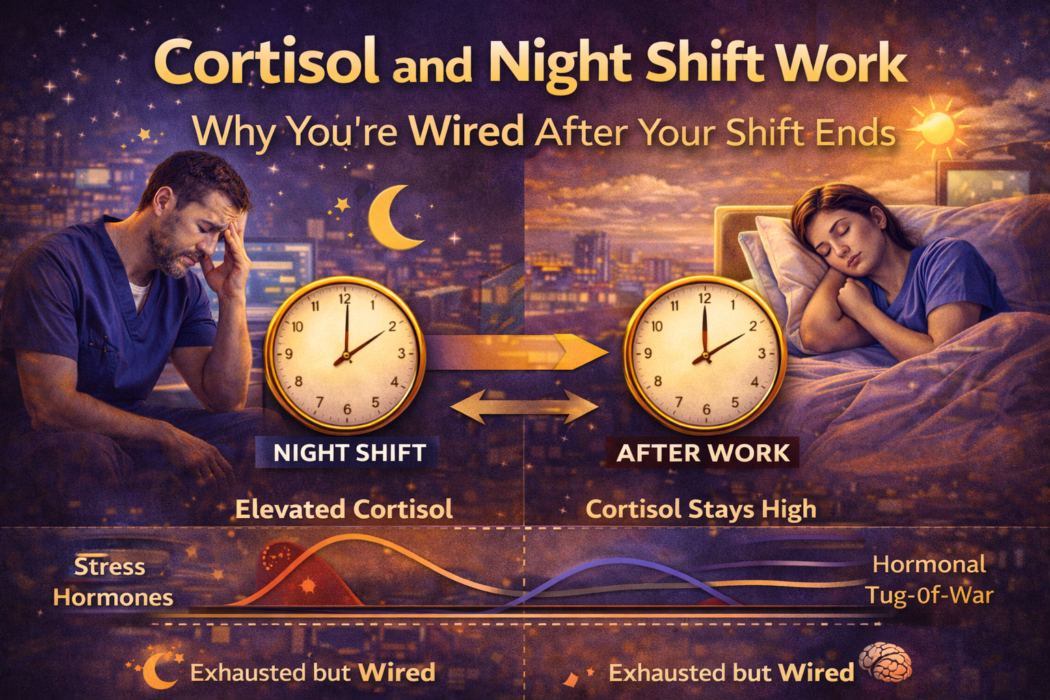
Night shift work flips this system upside down.
Instead of cortisol rising in the morning and falling at night, night shift workers often experience:
- Elevated cortisol during the night shift
- Delayed cortisol decline after work
- Cortisol spikes when trying to sleep during the day
This creates a biological contradiction:
Your body is exhausted — but your stress system is still active.
Why You Feel “Tired but Wired” After a Night Shift
Cortisol doesn’t just respond to psychological stress. It responds to:
- Bright light exposure
- Mental demand
- Noise
- Physical activity
- Sleep deprivation
Night shifts combine all of these.
By the time your shift ends:
- Cortisol could still be elevated.
- Your nervous system remains in alert mode.
- Melatonin release is suppressed by daylight.
This is why trying to sleep after work commonly feels harder than staying awake during the shift.
Cortisol vs Melatonin: A Hormonal Tug-of-War
Sleep depends on a handoff between cortisol and melatonin.
In healthy timing:
- Cortisol goes down → melatonin goes up → sleep happens.
In night shift workers:
- Cortisol stays high
- Melatonin release is delayed or suppressed.
- Sleep becomes shallow, fragmented, or delayed.
No amount of exhaustion overrides this hormonal conflict.
Why Traditional Sleep Advice Fails Night Shift Workers
Most sleep advice assumes:
- Cortisol naturally falls at night.
- Darkness signals sleep
- Early daylight signals wakefulness.
For night shift workers, this advice can backfire.
Examples:
- “Get morning sunlight” → raises cortisol after your shift.
- “Go to bed earlier.” → cortisol still too high
- “Just relax” → nervous system remains activated.
This is why night shift sleep problems are not the same as regular insomnia.
👉 Related: Sleep Tips for Night Shift Workers
How Cortisol Impacts Sleep Quality (Not Just Falling Asleep)
Even when night shift workers do fall asleep, elevated cortisol can:
- Reduce deep sleep
- Fragment REM cycles
- Increase night wakings
- Cause early awakenings
This leads to:
- Non-restorative sleep
- Brain fog
- Mood changes
- Increased reliance on caffeine
Over time, chronic cortisol disruption worsens overall sleep resilience.
Permanent Night Shifts vs Rotating Shifts: Cortisol Differences
Permanent Night Shifts
- Cortisol disruption is still present.
- But partial adaptation is possible with consistency.
- Sleep improves when timing is stable.
Rotating Shifts
- Cortisol rhythm never stabilizes.
- Frequent spikes occur during schedule changes.
- “Tired but wired” becomes more severe.
This is why rotating shifts are harder on sleep in the long term.
👉 Related: Best Sleep Schedule for Night Shift Workers (Permanent vs Rotating Shifts
Common Cortisol-Related Sleep Mistakes Night Shift Workers Make
Mistake #1: Too Much Light After Work
Morning light increases cortisol — exactly when it should be falling.
Mistake #2: Using Stimulants Too Late
Caffeine late in the shift extends cortisol elevation.
Mistake #3: Relying on Strong Sedatives
Sedation doesn’t lower cortisol — it just masks the symptoms.
Over time, this worsens sleep quality.
👉 Related: Why Sleep Aids Stop Working — And What Actually Fixes Chronic Insomnia
How to Lower Cortisol After a Night Shift (Practically)
You can’t eliminate cortisol — but you can reduce inappropriate activation.
1. Control Post-Shift Light Exposure
- Wear dark sunglasses outside.
- Keep indoor lights dim.
- Avoid screens in bed.
2. Create a Wind-Down Buffer
Treat the hour after your shift like a transition zone:
- Calm music
- Low stimulation
- No problem-solving or scrolling
3. Avoid “Sleep Pressure.”
Trying too hard to sleep increases cortisol.
Sleep improves when pressure decreases.
Why Stress Regulation Matters More Than Sedation
For night shift workers, the biggest sleep barrier is often the timing of stress hormones, not a lack of sleep drive.
This is why system-based, non-sedating support often works better than strong sleep aids.
One example is Yusleep, which is designed to:
- Support stress regulation
- Calm the nervous system.
- Improve sleep consistency without the need for next-day grogginess.
👉 See how Yusleep fits into a system-based approach for night shift sleep
The Cortisol–Gut–Sleep Connection (Often Overlooked)
Cortisol doesn’t just affect sleep; it affects digestion.
Night shift workers often experience:
- Digestive discomfort
- Irregular hunger
- Night wakings linked to gut activity
Chronic cortisol elevation can:
- Disrupt gut bacteria
- Increase inflammation
- Interfere with sleep hormone signaling.
This explains why gut health and sleep are closely linked for night workers.
👉 Related: Gut Health and Sleep
How Long Does It Take Cortisol to Normalize?
There’s no instant reset.
However, many night shift workers notice improvement within:
- 1–2 with steady light exposure and light control
- 2–4 weeks of stable sleep timing
- Ongoing stress-regulation support
Consistency matters more than perfection.
How This Fits Into Your Night Shift Sleep System
Cortisol management is one piece of the puzzle.
Best results come from combining:
- Sleep scheduling
- Light management
- Stress regulation
- Strategic naps
- Supportive routines
If you want a practical starting point:
👉 Sleep Tips for Night Shift Workers
If you want a checklist approach:
👉 10 Proven Sleep Tips for Shift Workers
Final Thoughts: You’re Not Failing Sleep — Biology Is Fighting You
If you feel wired after night shifts, it’s not because you’re doing something wrong.
It’s because cortisol — a hormone designed to protect you — is firing at the wrong time.
Once you stop fighting your stress system and start working with it, sleep becomes:
- More predictable
- Restorative
- Less frustrating
The goal isn’t perfect sleep.
It’s better sleep on an imperfect schedule.