Finding the best natural sleep aid that actually works can feel impossible.
One doctor says melatonin is safe. Another warns against it. Magnesium comes in a dozen forms. Herbs sound promising—but which ones are backed by science, and which are just marketing?
For many, the real problem isn’t a lack of options. It’s conflicting advice, inconsistent results, and the frustration of spending money on supplements that support temporarily, then stop working.
This guide breaks through the noise by delivering straightforward, doctor-informed advice on what actually works.
Discovering the best natural sleep aid can transform your nightly routine.
Below is a doctor-informed list of science-backed natural sleep ingredients. It outlines what they are recommended for, when they help, and when they might not, helping you make educated decisions and reduce trial-and-error frustrations.
Many people turn to natural sleep ingredients without realizing that everyday factors like caffeine may still be disrupting sleep quality, even when they feel exhausted. We explain this in detail in does caffeine affect sleep even if you feel tired, including how it reduces deep, restorative sleep.
How Doctors Evaluate Natural Sleep Ingredients
Sleep specialists don’t judge supplements by hype. They look at how sleep works biologically.
When evaluating natural sleep ingredients, clinicians typically consider:
- Does it support sleep onset, sleep maintenance, or sleep quality?
- Does it calm the nervous system or merely sedate?
- Is there evidence for short-term and long-term use?
- Does it interfere with natural sleep hormones?
- Does it create tolerance, rebound wake-ups, or grogginess?
Ingredients that work with the body—not against it—tend to perform best over time.
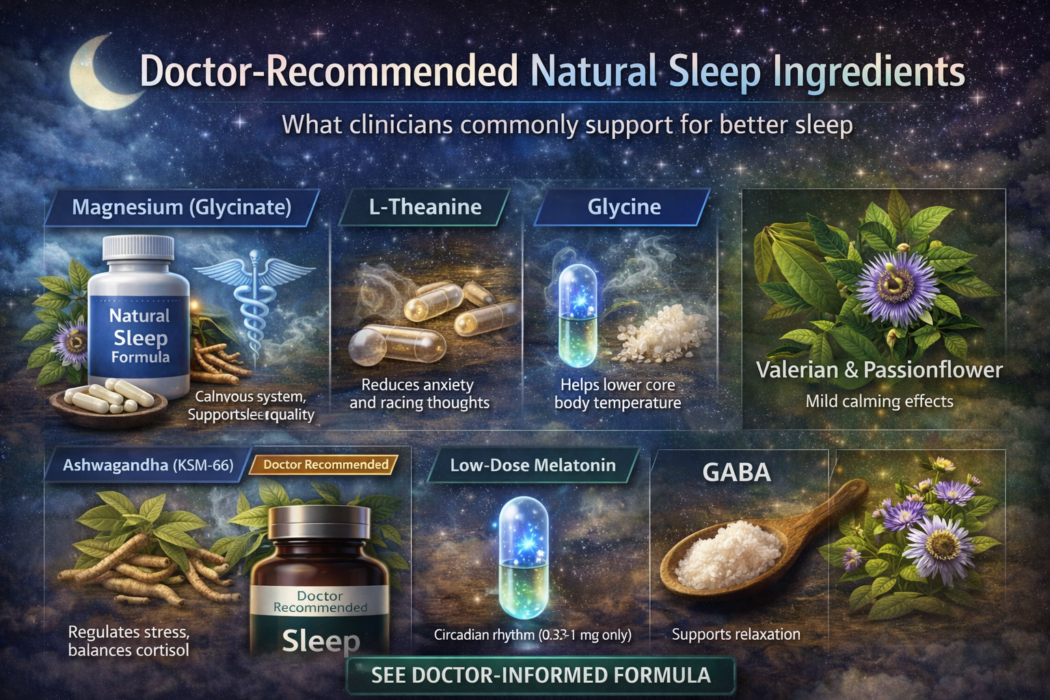
Top Doctor-Recommended Natural Sleep Ingredients (At a Glance)
Below is a curated list of ingredients commonly supported or cautiously recommended by sleep clinicians when used properly.
Not all are right for everyone. Combining them improperly is one of the biggest reasons sleep aids fail.
1. Magnesium (Glycinate or Threonate)
Best for: Stress-related sleep issues, light sleep, muscle tension
Supports: Sleep quality, nervous system calm
Magnesium plays a direct role in calming the nervous system and regulating neurotransmitters involved in relaxation.
Doctors often recommend magnesium glycinate or magnesium threonate because:
- They’re better absorbed.
- Less likely to cause digestive upset
- Support calmness without sedation.
What to avoid: Magnesium oxide (poor absorption)
👉 Related: Why Sleep Aids Stop Working (And What Actually Helps)
2. L-Theanine
Best for: Racing thoughts, sleep anxiety
Supports: Sleep onset, mental calm
L-theanine promotes alpha brain waves—associated with calm alertness—without sedation.
Clinicians often suggest it for:
- “Tired but wired” sleep
- Stress-driven insomnia
- People sensitive to stronger sleep aids
It works best when paired with other sleep-quality supports, rather than used alone.
3. Magnesium Glycine
Best for: Falling asleep faster, deeper sleep perception
Supports: Sleep onset and body temperature control
Magnesium Glycine helps lower core body temperature—an essential signal for sleep.
Doctors sometimes recommend it because:
- It doesn’t suppress melatonin.
- It improves subjective sleep quality.
- It doesn’t cause next-day grogginess.
It’s subtle but effective when used consistently.
4. GABA (Gamma-Aminobutyric Acid)
Best for: Nervous system overactivation
Supports: Relaxation, sleep initiation
GABA is the brain’s primary inhibitory neurotransmitter.
Doctors are cautious with oral GABA, but some patients report benefits—especially when combined with ingredients that support GABA signaling rather than forcing it.
👉 Related: GABA and Sleep: The Calming Neurotransmitter Many Insomniacs Are Missing
5. Ashwagandha (KSM-66 or Sensoril)
Best for: Stress-driven insomnia
Supports: Cortisol regulation, sleep stability
Ashwagandha is one of the most studied adaptogens for stress and sleep.
Doctors often recommend it when:
- Cortisol is elevated at night.
- Sleep issues are tied to anxiety or burnout.
- Early morning awakenings are common.
It works best over time, not as a quick fix.
6. Valerian Root
Best for: Short-term sleep onset issues
Supports: Sedative effects
Valerian has mixed evidence. Some clinicians recommend it cautiously for short-term use.
Known disadvantages:
- Grogginess
- Vivid dreams
- Tolerance with regular use
Not ideal for long-term or chronic insomnia.
7. Melatonin (Low-Dose Only)
Best for: Circadian rhythm disruption
Supports: Sleep timing (not sleep intensity)
Melatonin is one of the most misunderstood sleep supplements. It is a signal for the brain not a sedative.
Doctors generally recommend:
- 0.3–1 mg, not high doses
- Short-term or situational use (jet lag, shift work)
High doses can worsen sleep quality and suppress natural production.
👉 Read more at: How to Reset Your Circadian Rhythm Naturally
8. Passionflower
Best for: Mild anxiety-related sleep issues
Supports: Nervous system calming
Passionflower may support GABA signaling and relaxation, especially when paired with other calming ingredients.
Evidence is modest, but clinicians sometimes recommend it as part of a blend.
9. Tryptophan / 5-HTP (Situational Use)
Best for: Low mood–related sleep issues
Supports: Serotonin → melatonin pathway
Doctors approach these cautiously due to:
- Interaction potential
- Sensitivity differences
- Risk of overuse
These are typically not first-line recommendations.
Comparison Table: Doctor-Recommended Sleep Ingredients
| Magnesium (Glycinate) | Stress, sleep quality | Moderate | Yes |
| L-Theanine | Racing thoughts | Yes | Yes |
| Glycine | Sleep onset | Yes | Yes |
| Ashwagandha | Cortisol, anxiety | No (gradual) | Yes |
| GABA | Nervous system calm | Yes | Mixed |
| Melatonin (low dose) | Timing issues | Yes | Situational |
| Valerian | Sedation | Yes | No |
😴 Many people focus on sleep aids without fixing the basics first.
Some habits quietly sabotage deep, restorative sleep—especially for night shift workers. We break these down in common sleep mistakes that reduce recovery so you can avoid the ones that matter most.
Buying Guide: What Doctors Warn Against
Many sleep supplements fail because they:
- Focus on sedation instead of sleep quality.
- Use excessive melatonin doses.
- Rely on a single ingredient.
- Ignore stress hormones entirely.
Doctors increasingly recommend multi-ingredient approaches that support:
- Nervous system calm
- Stress regulation
- Sleep depth
- Consistency over time
👉 Related: Fast-Acting vs. Sustained-Release Sleep Aids
Where Yusleep Fits Into a Doctor-Informed Approach
Many people don’t need stronger sleep aids. They need better-designed support.
Yusleep is built around:
- Supporting sleep quality, not knock-out sedation
- Calming stress signals
- Helping sleep stay stable through the night.
- Avoiding tolerance and rebound wake-ups
- Low melatonin (0.9mg)
- Non-groggy
Instead of relying on a single ingredient, it reflects how doctors think about sleep: multifactorial, not one dimensional.
👉 See how Yusleep supports deeper, refreshing sleep and is all natural
Final Thoughts: Choosing the Best Natural Sleep Aid
The best natural sleep aid isn’t universal. It depends on:
- Why does your sleep break down
- Whether stress, timing, or depth is the issue
- How sensitive are you to sedatives?
- Whether your problem is occasional or chronic
- Melatonin strength
Doctor-recommended ingredients work best when:
- Used appropriately
- Combined thoughtfully
- Matched to your specific sleep pattern
- All natural
If you’ve tried everything and nothing sticks, the issue may not be effort. It may be strategy.